

Global Broker Regulation Inquiry App
About WikiFX
English
简体中文
繁體中文
English
Pусский
日本語
ภาษาไทย
Tiếng Việt
Bahasa Indonesia
Español
हिन्दी
Filippiiniläinen
Français
Deutsch
Português
Türkçe
한국어
العربية
اردو


How a 'Legitimate' Investment Became a RM67.5 Million Ponzi Scheme That Scammed 206 Investors

WikiFX
|


Abstract:Not all Ponzi schemes begin as obvious scams. Many are presented as legitimate investment opportunities, backed by established businesses, recognised individuals or convincing business models that appear credible on the surface.
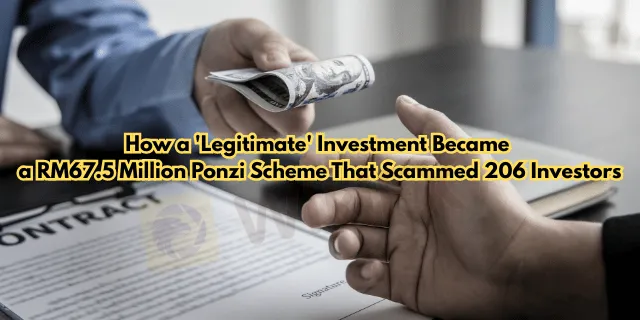
Not all Ponzi schemes begin as obvious scams. Many are presented as legitimate investment opportunities, backed by established businesses, recognised individuals or convincing business models that appear credible on the surface. The latest High Court ruling involving MYAirline co-founder Goh Hwan Hua serves as a reminder that investors should never rely solely on a project's reputation or the people behind it. Regardless of the size of an investment or the prominence of its founders, thorough due diligence remains essential before committing any funds.
The High Court in Kuala Lumpur has ordered Goh and several companies linked to him to repay RM67.56 million to 206 investors after ruling that the investment programme they operated was an illegal deposit-taking scheme that functioned as a Ponzi operation.
The judgment marks a significant victory for investors who claimed they were persuaded to invest between 2018 and 2023 through a series of financial products that promised guaranteed monthly returns. The court found that the scheme was unlawful from the outset and that investors had been misled about both its structure and its compliance with Islamic finance principles.
According to a statement issued by law firm Zharif Nizamuddin, which represented the investors, Justice Leong Wai Hong entered judgment in default on 16 July after the defendants failed to respond to the lawsuit despite being properly served with the legal documents. The defendants neither entered an appearance nor filed a defence.
In its ruling, the court concluded that Goh and the companies involved operated as a single economic unit, describing the arrangement as an “ecosystem scheme”. It also determined that Goh was the controlling figure behind the entire operation.
The court further ruled that the investment agreements signed by investors were void from the beginning because they formed part of an unlawful scheme. It found that investment products promoted as shariah-compliant did not meet those standards and that investors had been misled through false or deceptive representations.
As part of the judgment, Goh and the related entities were held jointly and severally liable for the losses. They were ordered to repay the full RM67,556,087 invested by the 206 plaintiffs, together with pre-judgment interest calculated at the fixed deposit rate and post-judgment interest of 5% a year until the amount is settled.
In addition to the repayment order, the court directed the defendants to disclose full details of their bank accounts and financial transactions. The disclosure is expected to assist the investors' legal team in tracing assets and recovering funds. The court also awarded RM80,000 in legal costs to the investors.
The lawsuit centred on investments made over a five-year period through a range of financial instruments, including letters of participation, partner financing agreements and share subscription agreements for redeemable preference shares. Investors alleged they were encouraged to participate by assurances of fixed monthly returns, a characteristic commonly associated with fraudulent investment schemes.
The legal action is also part of a wider effort to recover investor losses. On 28 February 2025, the same group of 206 investors filed a fresh lawsuit naming Goh alongside 30 other defendants, including individuals, companies, a law firm and a shariah consultancy firm.
Among the entities named in the proceedings are I-Serve Technology and Vacations Sdn Bhd, I-Serve Travels & Tours Sdn Bhd, I-Serve Online Mall Sdn Bhd, Tawafuq Consultancy Sdn Bhd, Bright Moon Venture PLT, MM2217 PLT and QA Smart Partnership PLT.
The case is one of the largest investor recovery actions linked to an alleged illegal investment scheme in recent years. It also highlights the increasing scrutiny of investment programmes that promise guaranteed returns while operating outside Malaysia's regulated financial system.
While the court found that the investment programme operated as a Ponzi-style scheme, the case also underlines a broader lesson for investors. Not every Ponzi scheme appears suspicious from the outset. Many are packaged as genuine investment opportunities, ranging from small private ventures to large-scale business projects associated with reputable companies or well-known entrepreneurs. Investors often only realise something is wrong when withdrawals are delayed, additional payments are demanded or promised returns fail to materialise.
Ultimately, the case serves as a reminder that no investment is free of risk, regardless of the size of the project or the reputation of the people behind it. Well-known brands, successful founders and polished marketing materials should never replace independent verification. Before committing funds, investors should conduct thorough due diligence, understand how returns are generated, verify whether the investment and its promoters are properly authorised where required, and assess the risks involved. Careful research remains one of the most effective ways to protect against both fraudulent schemes and unsuitable investment opportunities.
Disclaimer:
The views in this article only represent the author's personal views, and do not constitute investment advice on this platform. This platform does not guarantee the accuracy, completeness and timeliness of the information in the article, and will not be liable for any loss caused by the use of or reliance on the information in the article.
WikiFX Broker
Latest News
ForexMart Review: Profit Canceled, Principal Withheld, and a Broker Warning Traders Cannot Ignore
WikiFXBX Trade Review: Is This Unregulated Broker Worth the Risk?
WikiFXSTMARKET Review: Withdrawal Complaints Cloud a Low-Rated Broker, What to Know Before You Deposit
WikiFXWhy the Dollar Moves Almost Every Forex Pair
WikiFXCONSOB Orders Blocking of 24 Unauthorized Investment Websites
WikiFXBitDelta Receives UAE Category 5 Licence for Introducing Activities
WikiFXRinggit Gains on Majors but Slips vs US Dollar Ahead of Fed
WikiFXtrading.com Review: FCA-Regulated, But Withdrawal Complaints Persist
WikiFXDeriv Review: What Traders Should Know Before Depositing
WikiFXDollar Steadies as Rupee Finds Market Support
WikiFX