

Global Broker Regulation Inquiry App
About WikiFX
English
简体中文
繁體中文
English
Pусский
日本語
ภาษาไทย
Tiếng Việt
Bahasa Indonesia
Español
हिन्दी
Filippiiniläinen
Français
Deutsch
Português
Türkçe
한국어
العربية
اردو


Deriv Review: What Traders Should Know Before Depositing

WikiFX
|


Abstract:Deriv holds legitimate licenses in Malta and the UAE, but a WikiFX score of 2.46 and recurring withdrawal complaints from traders across multiple countries raise serious questions about fund safety. This article examines the complaint patterns, regulatory warnings, and what traders should verify before depositing.
Deriv is a broker that has been operating since 1996, offering forex, indices, stocks, commodities, cryptocurrencies, and ETFs across multiple platforms including Deriv MT5, Deriv X, and Deriv cTrader. On paper, it holds regulatory licenses from the Malta Financial Services Authority (MFSA) and the UAE's Capital Market Authority (CMA), alongside offshore registrations in the British Virgin Islands, Cayman Islands, and Vanuatu.
Despite these credentials, Deriv carries a WikiFX score of just 2.46 out of 10 , a rating that reflects a sustained pattern of user complaints and regulatory scrutiny. Across WikiFX's complaint channels, traders from multiple countries have reported strikingly similar experiences: accounts frozen without clear justification, withdrawals blocked for months, and funds returned only after escalation to regulators. If you are considering depositing with Deriv, the data suggests you have reason to pause and verify what protections actually apply to your account.
 Contents
Complaint Pattern Analysis
The complaints lodged against Deriv on WikiFX do not read like isolated disputes. They follow a recurring script that spans continents.
Withdrawals blocked after profitable trading. A recurring theme in user complaints is that accounts function normally during the deposit and early trading phase, but problems surface the moment a trader tries to withdraw , especially after a period of profitable trading. One user reported that their account was suddenly frozen after consistent gains, with customer service then demanding extensive documentation far exceeding standard Know Your Customer requirements. After all documents were submitted, according to the complaint, the user was asked to pay an additional fee to release their funds , and bank inquiries revealed the money had been moved to an offshore account.
Excessive document demands and partial refunds. Another user reported that their account was disabled with what the user described as baseless allegations. According to the complaint, the platform unilaterally withdrew a substantial sum and shifted the funds into a separate wallet. The user was then subjected to over a year of repeated document requests before the refund was finally processed , and only after the user escalated the matter to multiple regulators across several jurisdictions. The complaint states that compensation for financial losses and other damages remains unresolved.
Deposit accepted, refund denied. In a case from Nigeria, a user reported depositing funds using a friend's payment card. According to the complaint, the deposit was accepted without objection, but when the user later tried to withdraw, the platform flagged the third-party card usage and , after what the user describes as significant pressure , refunded only a fraction of the deposited amount. The user states that the outcome felt deliberately unfair given that the deposit was never rejected at the point of funding.
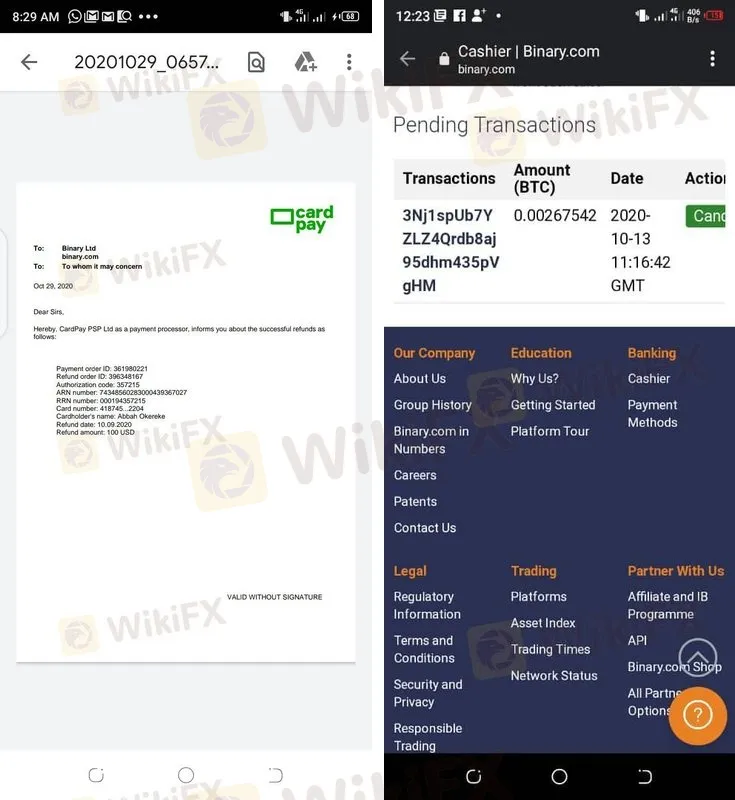
Screenshot submitted by the user with the complaint (2020-10)
Execution quality concerns. Beyond withdrawal issues, a user from Pakistan described significant order slippage during what they characterized as normal market conditions , not just around major news events. The complaint states that this turned potentially profitable trades into losing ones.
Market manipulation allegations. A user from Venezuela claimed the platform engages in a pattern where traders are initially allowed to win, after which losses accumulate until the account is depleted. While such claims are difficult to independently verify, the allegation echoes the experience reported by other users who describe a sudden change in their trading outcomes after periods of profitability.
What stands out across these complaints is the geography: Nigeria, Indonesia, India, Pakistan, Iraq, Venezuela. These are predominantly emerging-market jurisdictions where traders may have limited practical recourse when disputes arise.
Regulatory Warning
Deriv's regulatory picture is layered, and understanding which license actually covers your account is critical.
The broker holds a Market Making License (MM) from the Malta Financial Services Authority (MFSA) under deriv INVESTMENTS (EUROPE) LIMITED, with license number C 70156. It also holds a license from the UAE's Capital Market Authority (CMA) under Deriv Capital Contracts & Currencies L.L.C. These are the strongest regulatory anchors.
However, Deriv also operates through entities registered under offshore frameworks: Deriv (BVI) Ltd. under the British Virgin Islands Financial Services Commission, Deriv Investments (Cayman) Limited under the Cayman Islands Monetary Authority, and Deriv (V) Ltd under the Vanuatu Financial Services Commission. These offshore regulatory regimes typically offer less robust client protections than full regulatory oversight in major jurisdictions, and traders should verify which entity holds their specific account.
More concerning is the regulatory disclosure record from Indonesia's Commodity Futures Trading Regulatory Agency (BAPPEBTI). Between 2022 and 2023, BAPPEBTI issued multiple public warnings and carried out domain blocking actions against entities offering commodity futures trading without Indonesian licenses. Deriv-related domains appeared in these enforcement actions. According to the disclosure details, BAPPEBTI stressed that every party conducting futures trading activities in Indonesia must have a permit from the agency and comply with Indonesian laws, regardless of any overseas regulatory status they may claim. The regulator further noted that it cannot facilitate mediation in disputes involving unlicensed entities, and that funds deposited with such entities are not held in segregated accounts approved by BAPPEBTI.
This means traders from jurisdictions where Deriv does not hold a local license may find themselves in a regulatory gap , depending on the specific entity they are contracted with and where their funds are held.
Basic Information
Deriv traces its origins to 1996, making it one of the longer-established names in the online trading space. The group's primary website is deriv.com, with regional portals including deriv.ae for the UAE market.
The platform offers trading across forex, indices, stocks, commodities, cryptocurrencies, and ETFs. Account types include Standard, Zero Spread, Swap-Free, Financial, Gold, and Financial STP. The minimum deposit starts as low as $5, and leverage reaches up to 1:1000 on forex , a level that dramatically amplifies both potential gains and losses.
Deriv supports the MT5 platform alongside its proprietary interfaces: Deriv X, Deriv cTrader, Deriv Trader, Deriv Bot, Deriv GO, and SmartTrader. According to the platform, deposit and withdrawal channels include credit and debit cards, online banking, mobile payments, e-wallets, and cryptocurrencies.
Score and Influence
Deriv's WikiFX score of 2.46 places it in a category that demands serious caution. This score aggregates regulatory standing, complaint volume and severity, and overall market reputation.
The platform has attracted a substantial volume of user comments on WikiFX , a reflection of its significant global user base. However, the tone of those comments tells a troubling story. Complaints center disproportionately on withdrawal access, and the common thread is that resolving these issues requires escalation to regulators rather than resolution through normal customer support channels.
It is worth noting that Deriv does hold genuine regulatory licenses in Malta and the UAE, and some users have reported positive experiences, particularly regarding platform usability and the range of available instruments. The risk is that a trader's experience may depend heavily on which entity holds their account and whether they ever encounter a problem that requires meaningful customer support intervention.
Final Thoughts
Deriv presents a case where a long-established brand, legitimate European and Middle Eastern licenses, and a feature-rich trading platform coexist with a low trust score, repeated withdrawal complaints from multiple countries, and formal regulatory warnings from at least one national authority. The pattern in user complaints , accounts frozen after profitable trading, excessive document demands, and refunds only under regulatory pressure , is consistent enough that it cannot be dismissed as isolated incidents.
Before depositing with Deriv, confirm which specific entity will hold your account and check whether that entity's regulator offers meaningful protections for traders in your country. Start with a small deposit and test the withdrawal process early, before committing larger amounts. Use the WikiFX App to monitor real-time scores and read recent user complaints as they appear , patterns in complaint data can reveal risks that a broker's marketing materials will not. In an environment where regulatory gaps can leave traders with limited recourse, verifying before you deposit is not just a precaution , it is the only real protection you have.
Disclaimer:
The views in this article only represent the author's personal views, and do not constitute investment advice on this platform. This platform does not guarantee the accuracy, completeness and timeliness of the information in the article, and will not be liable for any loss caused by the use of or reliance on the information in the article.
WikiFX Broker
Latest News
Singapore tightens monetary policy in surprise move as rising oil prices rekindle inflation risk
WikiFXSPREDIX MARKETS Review: What Traders Should Know Before Depositing
WikiFXBXB Review – Zero Regulation, Dead Website: What Traders Need to Know
WikiFXHFM Review: No Regulatory Licences and a 1.83 Score , Is Your Deposit Safe?
WikiFXIs Your Withdrawal Plan Killing Your Compounding Gains?
WikiFXHFMARKETS TRADE Review: Zero Regulation and a Central Bank Warning
WikiFXWhy the Dollar Moves Almost Every Forex Pair
WikiFXChipmakers fall in US and Asia as AI jitters rattle investors
WikiFXBX Trade Review: Is This Unregulated Broker Worth the Risk?
WikiFXSTMARKET Review: Withdrawal Complaints Cloud a Low-Rated Broker, What to Know Before You Deposit
WikiFX