Abstract:OnFin review 2026: WikiFX score 2.05/10, no valid regulation, MT4/MT5 support, ultra-high leverage, withdrawal clause concerns, and complaints tied to account restrictions.

 Contents
What Is OnFin and What Does It Offer?
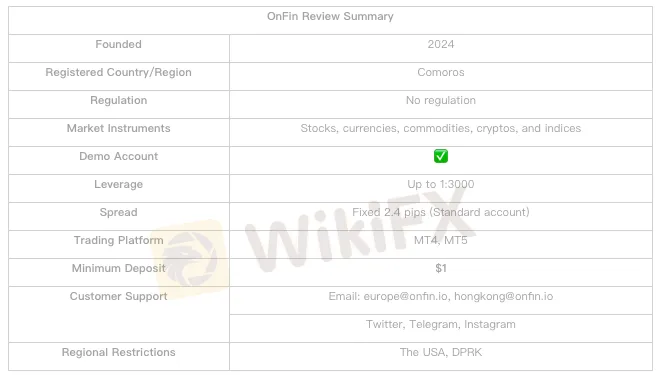
OnFin is a newer broker brand launched in 2024 and registered in the Union of the Comoros. It offers trading in stocks, currencies, commodities, cryptocurrencies, and indices, and supports both MT4 and MT5. The broker promotes fast order execution, multiple account types, demo access, and a low minimum deposit structure designed to appeal to retail traders.
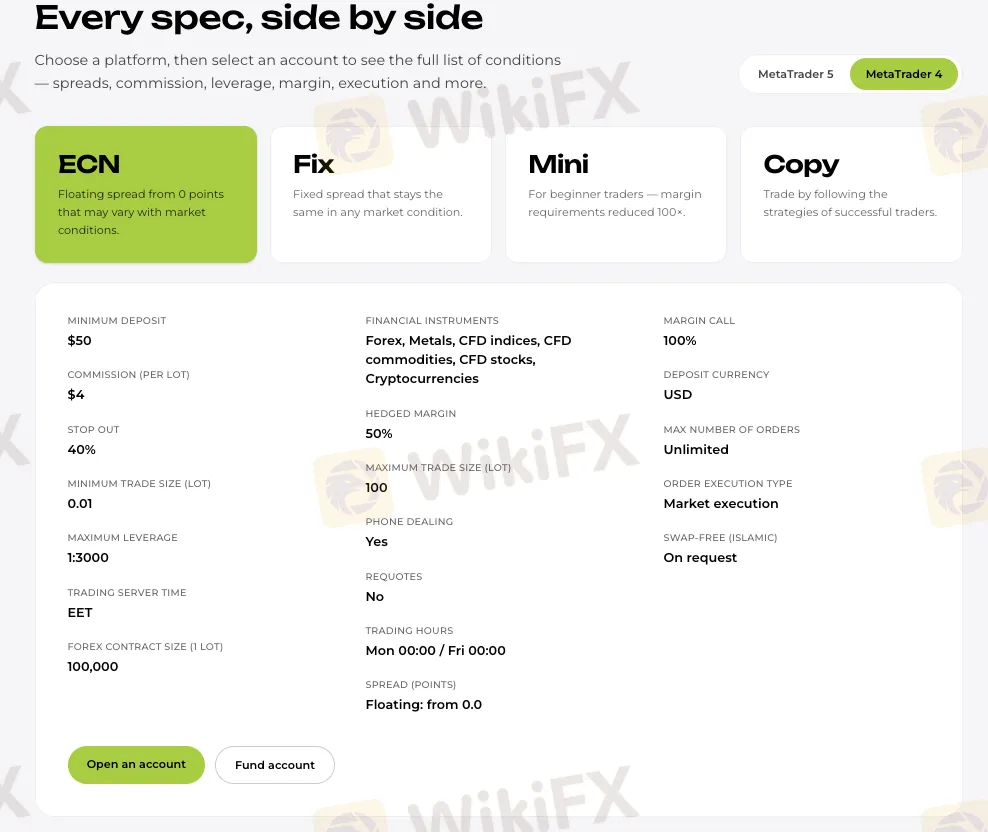
According to the available broker information, OnFin supports several account types across MT4 and MT5, with minimum deposits ranging from $1 to $100 depending on the account. The broker also promotes high leverage, while its website highlights trading access through web and mobile interfaces.
Its product structure is broad enough for beginner and higher-risk retail traders. The low deposit threshold, MT4/MT5 support, and copy-style account offering clearly position it as an accessible platform for fast account opening.
The same is true for its account setup. OnFin promotes several account types, including ECN, Standard, FIX, MINI, and COPY, with different deposit thresholds and platform combinations.
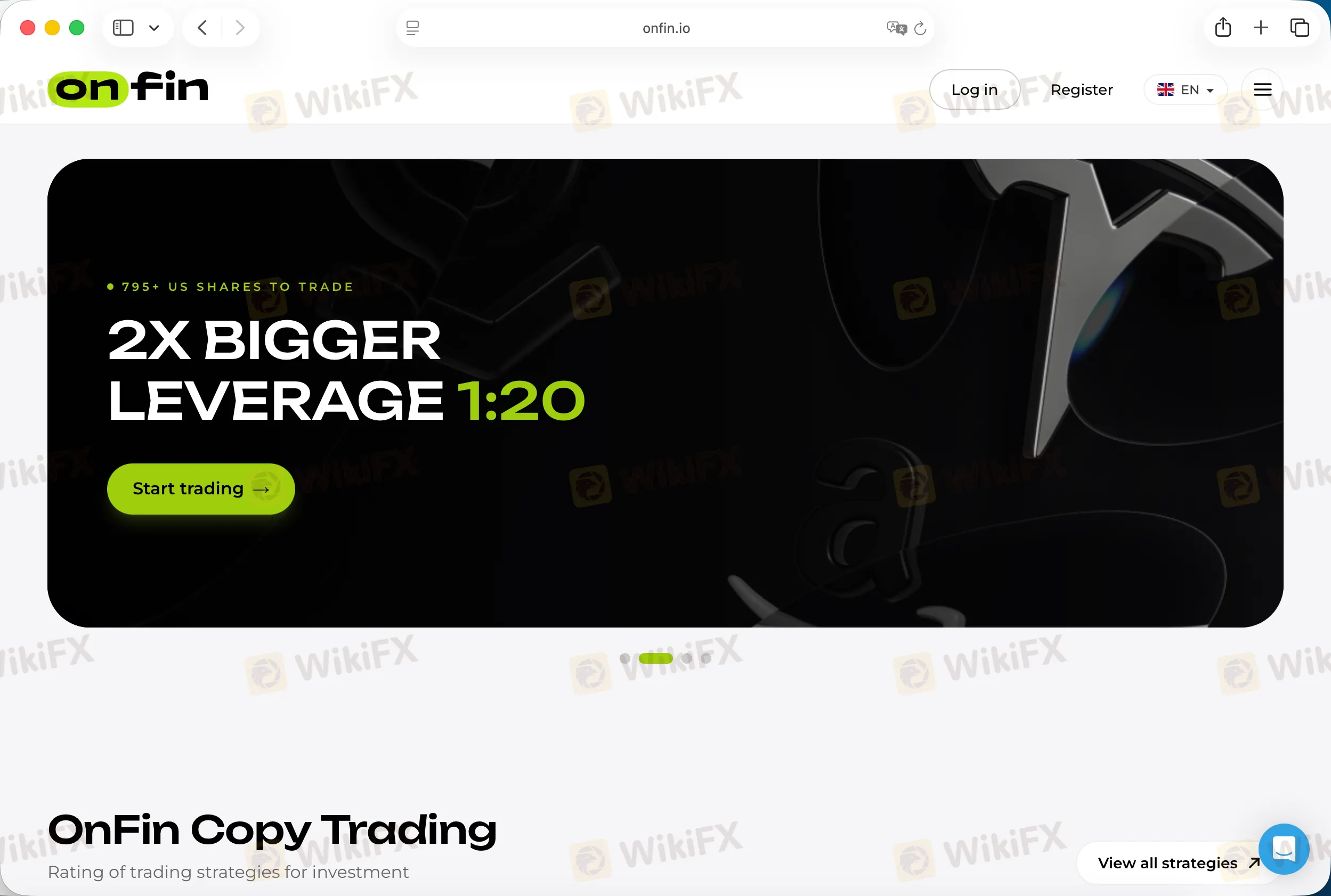
Its official website also emphasizes a modern retail-facing brand image and multiple product entry points, including copy trading and simplified account onboarding.
The full broker page is here:
https://www.wikifx.com/en/dealer/1763247389.html
Is OnFin Regulated or Not?
This is the most important question in any OnFin review.
Based on the available profile, OnFin is presented as a broker registered in the Comoros, but the key regulatory conclusion is much more direct: it is treated as a broker without valid regulation. That is also the core of the concern around OnFin license status.
The broker may present company registration and operating structure, but registration is not the same as holding a recognized forex regulatory license. In practical terms, the broker is treated as unregulated, and that becomes the starting point for any evaluation of safety.
What Does the WikiFX Score Say About OnFin?
The WikiFX score for OnFin is 2.05/10.
The breakdown shown in the profile includes:
- Regulation: 0.00
- License: 0.00
- Business: 5.65
- Software: 8.74
- Risk Control: 0.00
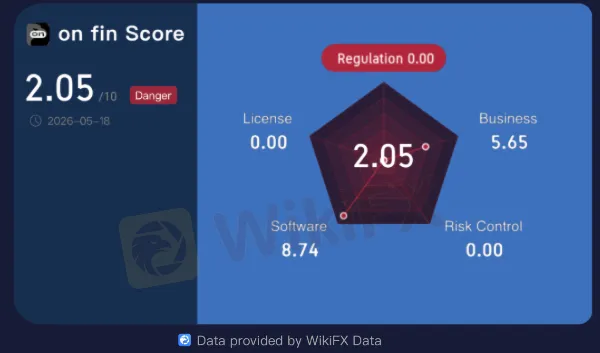
This five-part structure matters.
From a software perspective, OnFin looks better than many completely undeveloped brokers because it supports MT4 and MT5, which are familiar to many traders. But the strongest warning signs are in the areas that matter most for fund safety: regulation, license, and risk control.
For any discussion of OnFin rating, the main problem is not platform appearance. It is that the brokers regulatory and protection-related profile remains extremely weak.
Is OnFin Safe for Deposits and Withdrawals?
This is where the review becomes more serious.
From a pure product angle, OnFin may look convenient: low deposit thresholds, multiple account types, and easy retail access. But safety is not defined by convenience. It is defined by whether a broker has clear regulation, fair withdrawal conditions, and transparent account handling.
In OnFins case, the risk profile is weakened by three issues at the same time:
- no valid regulation
- very low trust score
- complaints tied to withdrawal restrictions and account treatment
That combination makes the answer to Is OnFin safe? difficult to frame positively.
Does OnFin Use MT4 and MT5?
Yes. OnFin supports both MT4 and MT5, and this is one of the stronger operational points in its profile.
For many traders, platform familiarity matters. MT4 remains widely used by newer retail traders, while MT5 is often preferred by users looking for broader tools and more flexibility. In this respect, OnFins software side looks more developed than its regulatory side.
Still, platform support alone does not improve the brokers compliance status. A broker can offer mainstream software while still remaining weak in licensing and risk control.
What Is the Biggest Problem in the Client Agreement?
One of the clearest red flags in this review is not just the lack of regulation, but the withdrawal-related clause structurein the client agreement.
A key point repeatedly raised is Clause 20.1, often described as the suspicious non-trading operations clause. Under this structure, the broker may classify certain transactions as suspicious if the client has not traded enough volume before requesting a withdrawal.
The concern is the practical threshold attached to this. According to the complaint description and the clause interpretation, the broker may require the client to complete 3 lots of trading for every $100 withdrawn, and each position must remain open for at least 5 minutes, with profit or loss of at least 3 points, otherwise the transaction may be treated as abusive transfer activity.
This has been widely criticized as an unrealistic turnover barrier for ordinary retail traders, especially when it appears to affect access not only to bonuses, but also to deposited funds.
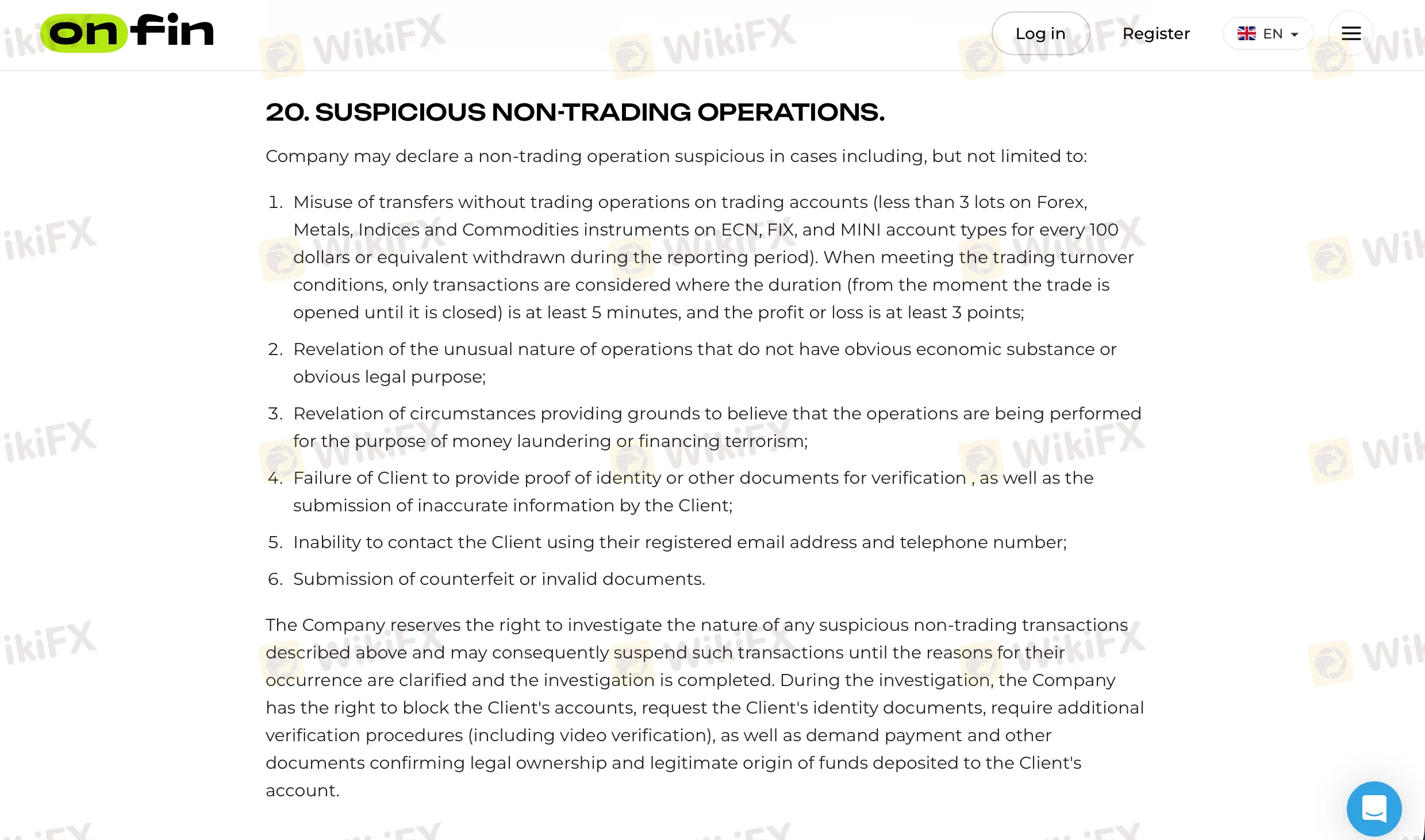
That is one of the main structural issues in the brokers withdrawal framework.
What Do User Complaints Say About OnFin Withdrawals?
A related WikiFX exposure describes this problem in more direct terms.
According to the complaint, the user attempted to make a withdrawal and was told that access to the funds would not be possible unless extremely high trading volume had first been completed. The user said the broker required 3 full lots for every $100 requested for withdrawal, and described that condition as unreasonable for normal retail traders. The complaint also said the platform pointed to vague clauses in the agreement and warned that refusal to comply could lead to account closure and broader internal reporting consequences.
Complaint link:
https://www.wikifx.com/en/exposure/detail/COG20250805074559049787870.html
In practical terms, the complaint s not just about delay. It is about whether the withdrawal framework itself is set up in a way that makes access to funds unnecessarily difficult.
Are There Hidden Fees on OnFin?
OnFin promotes zero deposit and withdrawal fees on the surface, but the fee structure is not as simple as that headline suggests.
One notable concern is the inactivity fee. If an account remains inactive for more than 60 days, the broker may charge up to $50 per month. That is significantly higher than what many traders would consider normal for a small retail account.
This matters because a broker can appear cheap at entry, then become more expensive through account maintenance conditions that many users do not notice upfront.
What Else Has WikiFX Reported About OnFin?
A related WikiFX article also discusses OnFin and the risks surrounding its operating model.
That report highlights the broker‘s low trust profile, regulatory weakness, and user concerns, while pointing readers toward the broader question of whether the platform’s conditions are designed more for acquisition than for fair client treatment.
Related WikiFX article:
https://www.wikifx.com/en/newsdetail/202508124384722247.html
For readers who want the broader background beyond the broker profile itself, that article is worth reviewing alongside the exposure record.
Is OnFin a Scam?
A careful review should avoid casual labels where the stronger issue is already clear from the facts.
The safer conclusion is this: OnFin presents a high-risk profile. It is treated as unregulated, it has a very low WikiFX score, and the withdrawal-condition controversy creates an additional layer of concern. That is enough to justify caution without needing exaggerated language.
Final Verdict: Should Traders Trust OnFin?
OnFin has some features that make it look attractive at first glance: MT4 and MT5 support, a modern retail-facing website, multiple account types, and a low deposit threshold.
But those points are outweighed by the bigger concerns: no valid regulation, WikiFX score of 2.05/10, 0.00 in regulation, 0.00 in license, 0.00 in risk control, aggressive turnover conditions tied to withdrawals, and complaint-based concerns about access to funds.
That leaves a cautious conclusion: OnFin may be easy to open and easy to fund, but it does not present a reassuring safety profile. Any trader considering this broker should review the legal terms, withdrawal conditions, and complaint history very carefully before depositing.
Frequently Asked Questions
Is OnFin regulated?
No. Based on the current profile, OnFin is treated as a broker without valid regulation.
Is OnFin trustworthy?
OnFin does not present a strong trust profile. Its very low WikiFX score, lack of valid regulation, and withdrawal-related concerns mean traders should approach it with caution.
What can I trade on OnFin?
OnFin offers trading in currencies, commodities, indices, cryptocurrencies, and stocks.
Does OnFin support MT4 and MT5?
Yes. OnFin supports both MT4 and MT5, which is one of the stronger operational points in its profile.
What is the minimum deposit on OnFin?
Depending on the account type, the minimum deposit can start from as low as $1.
Is OnFin suitable for beginners?
Its low deposit threshold and MT4/MT5 access may look beginner-friendly, but the weak compliance profile and withdrawal-related concerns make it a broker that beginners should assess very carefully.