

Global Broker Regulation Inquiry App
About WikiFX
English
简体中文
繁體中文
English
Pусский
日本語
ภาษาไทย
Tiếng Việt
Bahasa Indonesia
Español
हिन्दी
Filippiiniläinen
Français
Deutsch
Português
Türkçe
한국어
العربية
اردو


When Scammers Forge a Minister's Signature: Malaysia's Fake Investment Letter Exposed

WikiFX
|


Abstract:Datuk Seri Johari Abdul Ghani, Malaysia's Minister of Investment, Trade and Industry (Miti), came face to face with the problem in an unexpected setting. During a festive open house gathering, a member of the public approached him holding what appeared to be an official Miti letter and asked the minister himself to verify whether it was genuine.
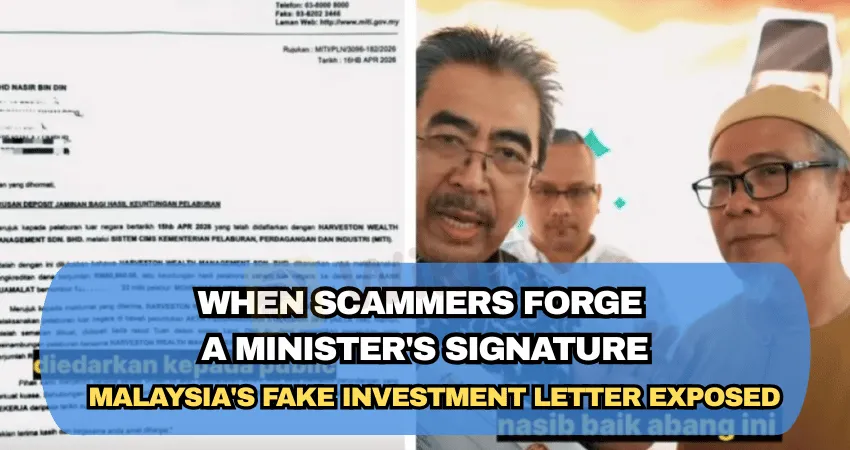
A high profile scam incident in Malaysia has raised fresh alarms about the growing audacity of fraud syndicates — this time, one brazen enough to forge official government correspondence bearing the name and letterhead of a sitting cabinet minister.
Datuk Seri Johari Abdul Ghani, Malaysia's Minister of Investment, Trade and Industry (Miti), came face to face with the problem in an unexpected setting. During a festive open house gathering, a member of the public approached him holding what appeared to be an official Miti letter and asked the minister himself to verify whether it was genuine. It was not.
The forged document carried the ministry's official letterhead along with national insignia, and was designed to convince recipients that they were entitled to overseas investment profits exceeding RM80,000. To access these supposed returns, targets were required to pay an upfront deposit of RM3,000 within three working days. The classic hallmarks of investment fraud were all present: urgency, false authority, and the irresistible promise of easy money.
Johari went public about the incident through a Facebook video, in which he introduced the individual who had brought the suspicious letter to his attention. The man had narrowly avoided falling victim. The minister used the moment to issue a clear public warning: neither he nor Miti has ever issued correspondence requesting payments or deposits in connection with investments of any kind. Any such letter, regardless of how convincing the official branding appears, is a forgery.
The ministry echoed this message through an official statement, urging Malaysians to remain vigilant and to report suspicious communications to the police without delay. The public was advised not to transfer money to any account mentioned in such letters, no matter how authentic the government imagery may look.
This incident is not an isolated case. Fraud syndicates across Malaysia have increasingly adopted tactics that involve impersonating credible institutions and public figures, from government ministries to banking officials, in order to lend a veneer of legitimacy to their schemes. The deliberate use of a minister's name and authentic looking government stationery represents a calculated and troubling escalation in these methods.
For everyday Malaysians, the case serves as a sobering reminder that scammers invest significant time and resources into making their deceptions appear real. Polished documents, familiar names, and promises of financial returns are precision tools designed to bypass natural scepticism.
Authorities continue to stress that no legitimate government agency or investment body will ever request upfront fees or deposits in exchange for investment profits. Members of the public who receive communications of this nature are strongly encouraged to verify directly with the relevant ministry or institution before taking any action, and to lodge a police report immediately.
In a landscape where fraud evolves faster than awareness, vigilance remains the most powerful shield available to ordinary citizens.
Disclaimer:
The views in this article only represent the author's personal views, and do not constitute investment advice on this platform. This platform does not guarantee the accuracy, completeness and timeliness of the information in the article, and will not be liable for any loss caused by the use of or reliance on the information in the article.
WikiFX Broker
Latest News
OANDA Broker: Regulated but Is It Really Safe for Traders?
WikiFXYen Surges on Joint Intervention
WikiFXVonway Review: Users Report Withdrawal Blocks and Account Freezes , What Traders Should Know
WikiFXMangaluru Woman, 61, Loses Rs 16.2 Lakh in Facebook Scheme
WikiFXATFX Trading Volumes Drop 29% After Record Q1
WikiFXAI GOLD Review: Is Your Deposit Safe?
WikiFXFD Review: What Traders Should Know Before Depositing
WikiFXWhy a 90% Win Rate Can Still Lose You Money
WikiFXRazor Markets Review: What Traders Should Know Before Depositing
WikiFXMASTER MIND CAPITALS Review: Withdrawal Complaints Pile Up Against This Unregulated Broker
WikiFX