

Global Broker Regulation Inquiry App
About WikiFX
English
简体中文
繁體中文
English
Pусский
日本語
ภาษาไทย
Tiếng Việt
Bahasa Indonesia
Español
हिन्दी
Filippiiniläinen
Français
Deutsch
Português
Türkçe
한국어
العربية
اردو


Fraudsters Impersonate Trade Ministry in Telegram Investment Scam

WikiFX
|


Abstract:Malaysia’s Ministry of Investment, Trade and Industry (MITI) has issued a public warning after fraudsters misused the name of its secretary-general in a fake investment scheme circulating on Telegram.
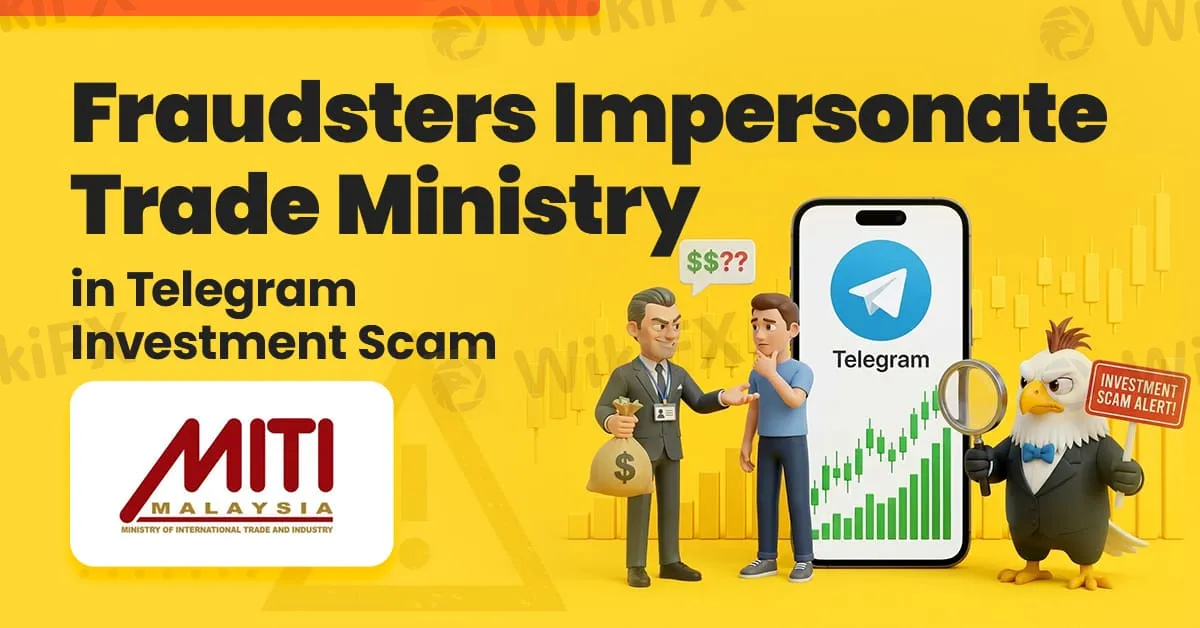
Malaysias Ministry of Investment, Trade and Industry (MITI) has issued a public warning after fraudsters misused the name of its secretary-general in a fake investment scheme circulating on Telegram.
The ministry confirmed that the name of its secretary-general, Datuk Hairil Yahri Yaacob, has been used without authorisation in a fraudulent investment operation on the messaging platform. According to MITI, the scheme operates through a Telegram channel titled “Ministry of International Trade and Industry”, a name deliberately chosen to create the impression of official government backing.
Authorities stressed that neither the ministry nor any of its officers is involved in the scheme. MITI stated clearly that it has no connection to any investment programme promoted on Telegram or other digital platforms under its name. The ministry also rejected any suggestion that its officials are participating in private investment offers.
The warning was issued through the ministrys official social media account on platform X, reflecting the seriousness of the matter and the need for rapid public awareness. Government agencies in Malaysia have increasingly relied on social media to counter misinformation and respond to fraudulent activity that spreads quickly online.
Investment scams conducted through messaging applications have grown more common across Southeast Asia. Fraudsters often create channels or groups using official-sounding names, government logos or references to senior public officials. These tactics are designed to build trust and reduce suspicion among potential victims.
In this case, the use of the secretary-generals name appears intended to reinforce the illusion of legitimacy. Senior civil servants hold positions of authority and oversight in key economic ministries. By associating a recognised official with an investment scheme, scammers seek to persuade individuals that the opportunity has government endorsement or regulatory approval.
MITI urged the public to exercise caution when encountering unsolicited investment offers on social media or messaging platforms. The ministry advised individuals to verify any claims through official government websites or recognised communication channels before committing funds or sharing personal details.
The ministry also warned against disclosing financial information to unknown parties online. Fraud schemes frequently rely on collecting banking details, identification numbers or upfront “processing fees” under the pretext of securing investment returns. Once funds are transferred, victims often find it difficult to recover their money.
While the ministry did not disclose the number of individuals affected by the Telegram scheme, its public statement suggests concern over potential financial harm. Investment scams can spread rapidly within messaging apps, where content is easily forwarded between users and groups.
For the broader financial services and online trading sector, the incident underscores a persistent challenge: the misuse of official identities to promote unregulated or fraudulent products. Scammers increasingly exploit the names of ministries, regulators and senior executives to give false credibility to their operations.
Such schemes not only expose retail investors to financial loss but also undermine public confidence in legitimate institutions. When official names are used without consent, the reputational damage can extend beyond immediate victims.
MITI encouraged individuals who encounter the fake Telegram channel or similar suspicious activity to report the matter to the relevant authorities. Complaints can also be lodged through the ministrys official communication channels. Early reporting, officials noted, is critical in preventing further harm and enabling enforcement agencies to investigate.
The case serves as a reminder that genuine government ministries do not promote private investment schemes through informal messaging platforms. Official announcements and programmes are communicated through verified websites, press releases and authorised media statements.
Digital fraud has become more sophisticated in recent years. The ease of creating social media profiles and messaging channels allows scammers to replicate official branding within minutes. In response, authorities across the region have stepped up monitoring and public awareness campaigns, though enforcement remains complex due to the cross-border nature of many online scams.
Investors are advised to approach high-return promises with scepticism, particularly when they appear linked to government agencies or senior officials without formal documentation. Verification through official portals remains the simplest and most effective safeguard.
Disclaimer:
The views in this article only represent the author's personal views, and do not constitute investment advice on this platform. This platform does not guarantee the accuracy, completeness and timeliness of the information in the article, and will not be liable for any loss caused by the use of or reliance on the information in the article.
WikiFX Broker
Latest News
admiral Review 2026: Clone Warnings, Withheld Profits, and Withdrawal Risks
WikiFXReview 2026: GFS Withdrawal Complaints, Regulation Gaps, and Broker Risk Signals
WikiFXReview 2026: XORKETS FX Withdrawal Complaints and Unregulated Risk
WikiFXTriumphFX Review: Revoked Licence and TFX Token Losses Warrant Caution
WikiFXValbury Review 2026: An A+++ Rating Is a Starting Point - Not a Reason to Skip the Money-Path Check
WikiFXGold Climbs Toward $4,400 as September Fed Hike Odds Tumble
WikiFXPlus500 Joins Bahamas Forex and CFD Industry Association
WikiFXTenTrade Review 2026: Complaints, Withdrawals, and Risk Signals
WikiFXStoneX Agrees to Acquire Brazil FX Bank Banco Travelex
WikiFXMalaysian Doctor Loses RM558,000 to Forex-Crypto Scam
WikiFX