

Global Broker Regulation Inquiry App
About WikiFX
English
简体中文
繁體中文
English
Pусский
日本語
ภาษาไทย
Tiếng Việt
Bahasa Indonesia
Español
हिन्दी
Filippiiniläinen
Français
Deutsch
Português
Türkçe
한국어
العربية
اردو


Malaysia’s Agrobank Suffers RM203 Million Loss in Online Fraud Breach

WikiFX
|


Abstract:Malaysia’s Agrobank has suffered losses of RM203.8 million from a large-scale online fraud linked to a system breach, prompting arrests, criminal charges and renewed urgency for tougher action against organised cybercrime.
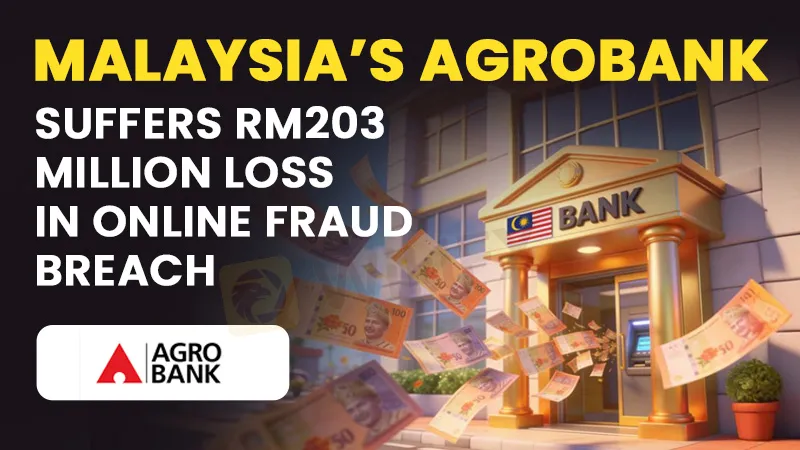
Malaysias struggle with online financial crime has come sharply into focus following the disclosure of a major fraud case involving Bank Pertanian Malaysia Bhd, better known as Agrobank. Authorities have confirmed that the state-owned lender suffered losses of RM203.8 million after falling victim to an online fraud incident reported in November last year.
Authorities have confirmed that 47 individuals have been arrested in connection with the case, highlighting the coordinated nature of the operation. Three suspects have been charged under Section 424C(1) of the Penal Code, which criminalises the use of bank accounts or payment instruments for unlawful purposes, including mule account activities. The law allows for prison sentences of up to 10 years, significant fines, or both, reflecting the seriousness of such offences.
Investigations into the remaining suspects are ongoing, with police working closely alongside CyberSecurity Malaysia and Bank Negara Malaysia to complete their findings. Officials have stressed that the fraud did not involve customer accounts, pointing instead to weaknesses linked to internal systems. This distinction, while reassuring for depositors, raises deeper concerns about institutional controls and internal safeguards.
Agrobank, which is fully owned by the Minister of Finance Inc and overseen by the Ministry of Agriculture and Food Security, acknowledged the issue publicly in mid-November. The bank stated that it had launched a comprehensive internal review following a systems-related incident. No further details were disclosed at the time. However, subsequent reporting suggested the breach may have involved an organised attempt to siphon funds using hundreds of linked accounts, underscoring the sophistication of the scheme.
The case has intensified scrutiny of Malaysias wider battle against online fraud. Between 2020 and 2025, the country recorded more than 209,000 online fraud cases, with total losses approaching RM8 billion. Telecommunications scams and e-commerce fraud accounted for the largest share, indicating that criminals are targeting both individuals and institutions through increasingly common digital channels.
Investment scams remain another fast-growing threat. In one high-profile case reported last year, victims lost approximately RM40 million to a fraudulent investment scheme that did not exist. The operation involved cryptocurrency transactions, with digital assets worth about US$6.4 million transferred across multiple crypto wallets, complicating efforts to trace and recover the funds.
In response to the rising threat, enforcement under Sections 424A to 424D of the Penal Code has been intensified. These provisions were introduced to address organised cybercrime more aggressively and impose tougher penalties that better match the scale of financial damage caused.
At the legislative level, the government is reviewing proposed amendments to the Penal Code, the Communications and Multimedia Act 1998, and laws governing money laundering and terrorism financing. The focus is on stronger penalties, wider asset forfeiture powers and tougher action against scam syndicates, mule account holders and facilitators.

Disclaimer:
The views in this article only represent the author's personal views, and do not constitute investment advice on this platform. This platform does not guarantee the accuracy, completeness and timeliness of the information in the article, and will not be liable for any loss caused by the use of or reliance on the information in the article.
WikiFX Broker
Latest News
LQH MARKETS Review: Multiple Traders Report Withdrawals Blocked and Accounts Terminated
WikiFXSpread Cheating: The Invisible Trading Cost That Could Be Working Against You
WikiFX"They Want to See Your Face": Inside ATFX Cambodia's Rise
WikiFXTrump Memecoin Faces SEC Scrutiny After Nearly One Million Investors Suffer Heavy Losses
WikiFXApple Faces Lawsuit Over Fake Crypto App Exposing $1.8 Million Theft
WikiFXBorn2trade Adds Copy Trading to 1:5000 Leverage Platform
WikiFXLevels Review: No Regulation and Mounting Withdrawal Complaints – What Traders Need to Know
WikiFXPILOTFX Review: What Traders Should Know Before Depositing
WikiFXLMAX Group Review 2026: Users Report Disturbing Withdrawal Issues - Is the Broker Still Reliable?
WikiFXLuno Review: Unregulated Broker Warning After Frozen Accounts and Blocked Withdrawals
WikiFX