


UK Retail Sales July 2026 Fall 0.5%: What the Result Means for GBP
UK retail sales fell 0.5% in July 2026, while the three-month measure rose 1.1%. See the ONS details and what the mixed result may mean for GBP.
Original

简体中文
繁體中文
English
Pусский
日本語
ภาษาไทย
Tiếng Việt
Bahasa Indonesia
Español
हिन्दी
Filippiiniläinen
Français
Deutsch
Português
Türkçe
한국어
العربية
اردو




Abstract:Japanese Yen (USD/JPY) Analysis: The yen ventures into critical territory as the BoJ meeting approaches. USD/JPY surpasses a significant threshold.
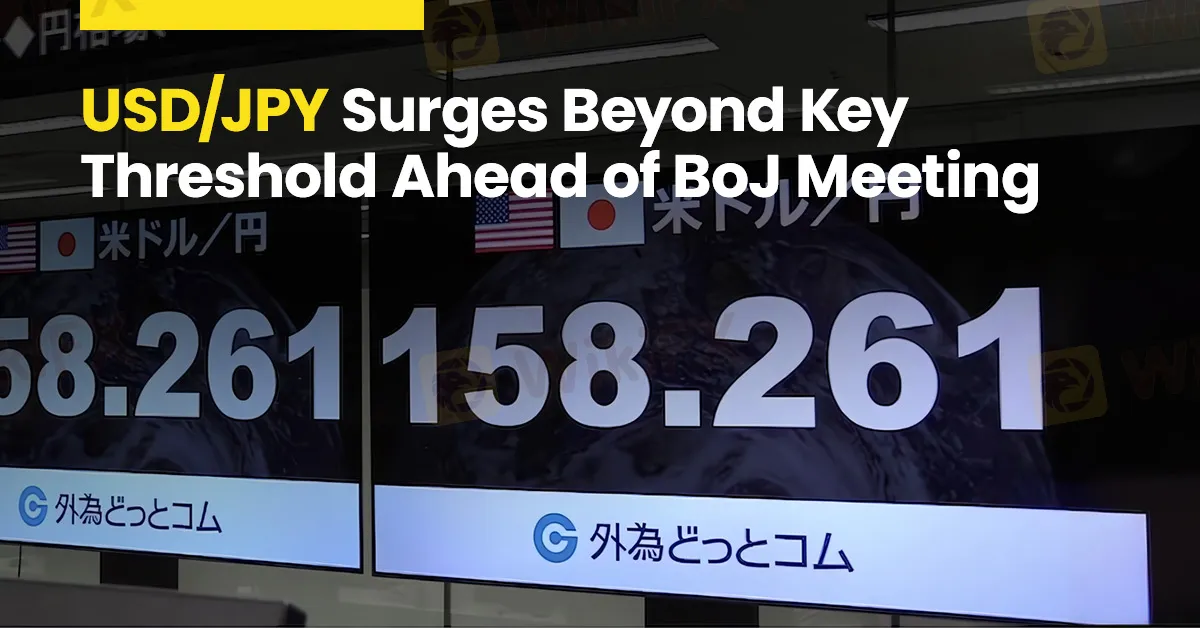
Japanese Yen (USD/JPY) Analysis:
The yen ventures into critical territory as the BoJ meeting approaches.
USD/JPY surpasses a significant threshold.
Will the BoJ's updated forecast bring the inflation objective within reach, given Governor Ueda's concerns about trend inflation?
Enhance your trading acumen and stay ahead of the curve. Access the Japanese yen Q2 outlook today for exclusive insights into pivotal market drivers every trader should be monitoring:
USD/JPY Breaks Through Critical Barrier Ahead of BoJ Meeting:
Yesterday, USD/JPY breached the 155.00 level, a threshold highlighted by former Deputy Finance Minister Michio Watanabe as one likely to trigger a response from Japanese authorities. As Thursday unfolds, the pair maintains its ascent beyond 155.00, poised before two potential dollar catalysts: US GDP (today) and PCE data (tomorrow).
Should US growth outperform expectations and PCE data reveal further setbacks to disinflationary trends, USD/JPY could see accelerated gains. The Atlanta Fed presently forecasts Q1 GDP at 2.7%, while economists anticipate a 2.5% growth rate for the first quarter.
The Bank of Japan (BoJ) aims to avoid replicating the dovish messaging preceding the 2022 FX intervention efforts that sent the yen plummeting. While BoJ Governor Kazuo Ueda has hinted at the possibility of raising interest rates if underlying inflation trends upward, he underscored on Tuesday that trend inflation remains slightly below 2%, shifting attention to the medium-term inflation projection accompanying the BoJ statement as the two-day central bank meeting nears its conclusion tomorrow.
In recent days, the yen has weakened against several major currencies, amplifying pressure on Japanese authorities to address the persistent devaluations of the domestic currency. While a weaker yen benefits Japanese exports, escalating input costs like fuel pose economic challenges, particularly amidst rising oil prices.
USD/JPY's breach of 155.00, anticipated for weeks, appears to have little impact on currency markets, even preceding the release of high-impact US data. The upper boundary of the longer-term ascending channel emerges as the next resistance level ahead of the 160.00 threshold.
With the BoJ likely maintaining rates unchanged, Kazuo Ueda's options are limited to tapering asset purchases (or signaling reduced bond acquisitions) or adopting a staunchly hawkish stance in his overall assessment. In the absence of BoJ or finance officials' action, momentum seems poised for further USD/JPY gains.
Conversely, swift developments may unfold if the Ministry of Finance intervenes. Previous interventions have witnessed USD/JPY plummeting by approximately 500 pips, highlighting the pair's volatility.

Disclaimer:
The views in this article only represent the author's personal views, and do not constitute investment advice on this platform. This platform does not guarantee the accuracy, completeness and timeliness of the information in the article, and will not be liable for any loss caused by the use of or reliance on the information in the article.

UK retail sales fell 0.5% in July 2026, while the three-month measure rose 1.1%. See the ONS details and what the mixed result may mean for GBP.

Pakistan forex reserves stood at $22.506 billion on 13 August 2026, while the SBP dashboard showed a USD/PKR mark to market rate of 277.5713 on 20 August. This article separates the SBP forex reserves facts from predictions about the Pakistan rupee and the forex market Pakistan.

A multi-asset liquidity solution can help a broker support FX, CFDs, commodities, and indices through a more unified operating model. But adding asset classes can also create fragmented symbols, pricing, routing, margin rules, records, and client messages if controls are not designed first. This 2026 guide explains how a multi asset liquidity provider, forex CFD liquidity setup, commodity liquidity provider, and indices liquidity provider fit into a broker-owned execution service. It outlines the due-diligence questions, shared-control model, cost drivers, and 90-day implementation plan that help teams expand without making the execution chain harder to explain. The aim is not to promise deeper liquidity or better trading outcomes. It is to create evidence that a broker can supervise market access, trace order events, reconcile costs, and communicate consistently to the relevant clients when conditions are difficult.

Gold surged above $4,500 after the US Treasury expanded its purchases of longer-dated government bonds, pushing yields and the dollar lower. But this was not debt forgiveness or Federal Reserve money printing—it was a liquidity operation that exposed a much bigger fear: America may be finding it increasingly difficult to live with market-driven interest rates.
WikiFXWikiFXWikiFXWikiFXWikiFXWikiFXWikiFXWikiFXWikiFXWikiFX