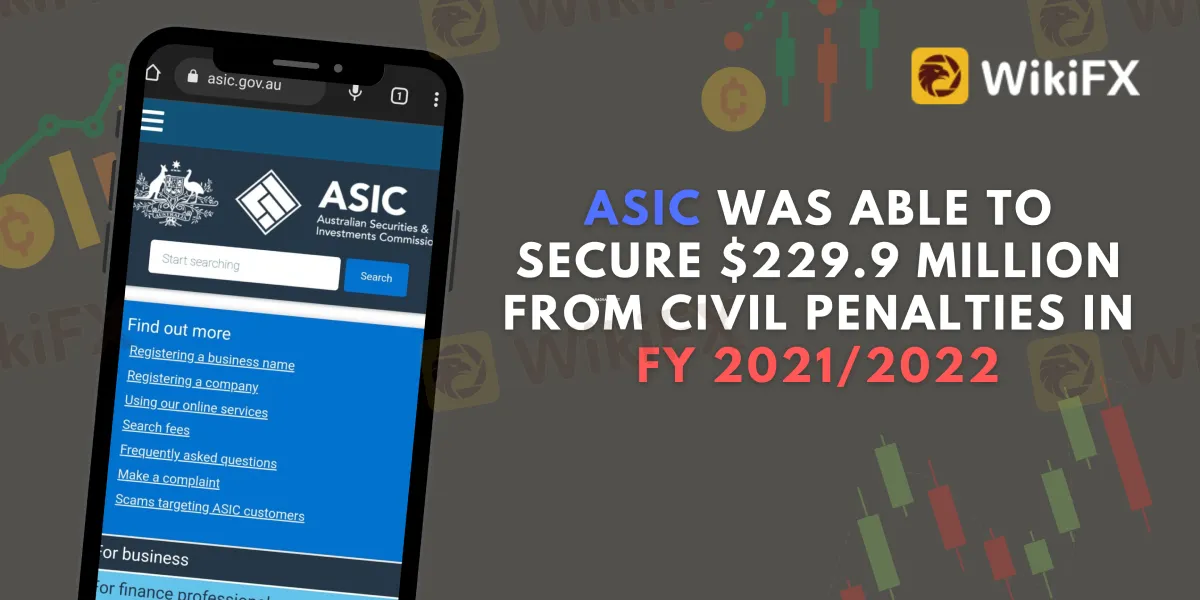
Abstract:Due to convicting a lot of people by doing illicit activities, ASIC was able to get funds from them.
The regulator was successful in convicting 33 people.
During this time, ASIC implemented breach reporting, hawker prohibitions, and postponed sales.
During the fiscal year, 2021–2021, the Australian Securities and Investments Commission (ASIC) collected a total of $229.9 million in civil penalties as a result of its enforcement operations.
During the same time period, 33 people were found guilty by the Australian regulator for corporate, market, and financial services.
This data was released in ASIC's Annual Report for 2021–2021, which highlights the agency's significant regulatory and enforcement activities throughout the fiscal year.
One of the most significant things ASIC did during this period was to defend customers' interests and reduce the risk of damage caused by poor design, distribution, and marketing.
ASIC said in August that its strategy for the next four years, from 2022 to 2026, will focus on how products are made and how they are sold, as well as technological risks.
ASIC also said that between 2021 and 2022, it put in place a framework for reporting breaches, a ban on hawkers, and a delayed sales model.
It says that the breach reporting mechanism encourages licensees to find and report violations as soon as possible, but the hawking restriction protects consumers from harm caused by unsolicited product pitches.
The sales model, on the other hand, seeks to “better customer outcomes in the add-on insurance market.”
'A Significant Law Reform Year'
In a statement published to the press on Friday, Joe Longo, the chairman of ASIC, said in a statement that the regulator's annual report “covered a year of major legal amendments following on from the Financial Services Royal Commission.”
ASIC said that it took “strong and focused action” to curb acts that were damaging to consumers and the financial industry's integrity.
After the data breach at Optus last month, the regulator warned market intermediaries like brokers about the risk of “identity theft and fraud.”
ASIC has also told brokers that they need to be careful when selling high-risk investment instruments or products to regular clients.
In August, the regulator said it was worried about brokers who said they were free or low-cost platforms.
ASIC said in a recent statement, “We have worked with the industry to make important changes that protect consumers and investors from unethical behavior by making financial service providers more responsible and subject to stronger laws.”
The ASIC Chair also said that the Commission's short-and medium-term business strategy focuses on areas of elevated consumer risk. Greenwashing claims and cryptocurrency investment schemes are examples of this.
According to its annual licensing report, which came out this month, ASIC gave out 578 new licenses for its fiscal year 2022.
Between July 2021 and June 2022, the number of new licenses issued increased by 26% year on year.
Stay tuned for more Broker News.
Download the WikiFX App from the App Store or Google Play Store to access the news on the go.