

Global Broker Regulation Inquiry App
About WikiFX
English
简体中文
繁體中文
English
Pусский
日本語
ภาษาไทย
Tiếng Việt
Bahasa Indonesia
Español
हिन्दी
Filippiiniläinen
Français
Deutsch
Português
Türkçe
한국어
العربية
اردو


US National Debt Nears $40 Trillion as Interest Costs Become the Government's Largest Expense


Abstract:[Figure 1: U.S. Market Overview]The U.S. national debt is now just $65 billion away from reaching the historic $40 trillion milestone. As of last Friday's market close, the largest psychological thres

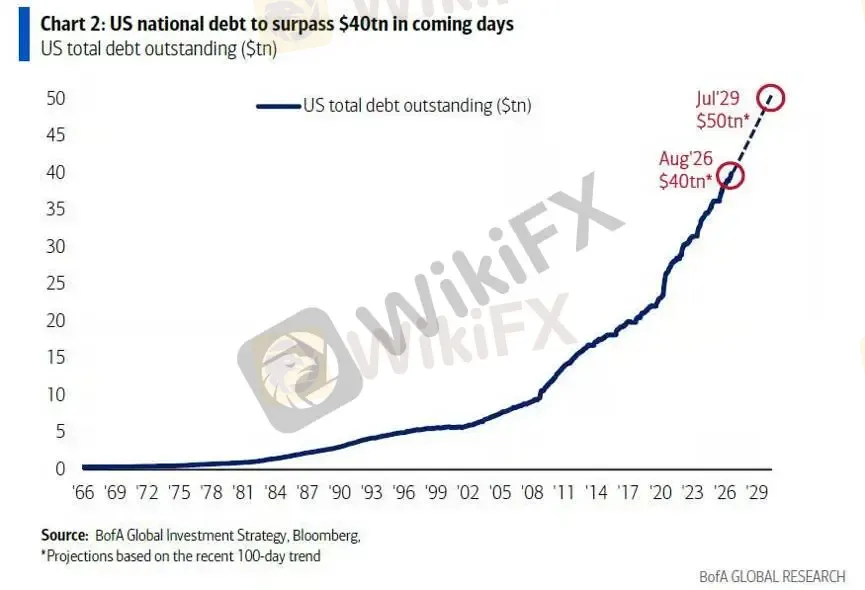
The U.S. national debt is now just $65 billion away from reaching the historic $40 trillion milestone. As of last Friday's market close, the largest psychological threshold in U.S. fiscal history is within striking distance.
In the latest edition of Flow Show, Bank of America's Chief Investment Strategist Michael Hartnett titled his report "Strife Begins at Forty," arguing that the approaching $40 trillion debt level has become the defining macro narrative for global markets.
Hartnett believes U.S. debt will not only surpass $40 trillion within days, but could climb to $50 trillion by around 2029. Against this backdrop, he continues to favor gold as the premier macro hedge, viewing it as the most effective protection against U.S. dollar depreciation, bond market deterioration, and asset inflation.
Over the past 12 months, the U.S. government's interest payments on outstanding debt have surged to $1.4 trillion, approaching Social Security as the federal government's largest single spending category.
Hartnett argues this trend is unlikely to reverse unless the 5-year Treasury yield falls below 3.25%, a scenario he considers highly improbable without a significant deflationary shock or recession.
Meanwhile, the U.S. Treasury auctioned 30-year bonds at a yield of 5.126% last week, the highest level in 25 years.
Hartnett summarized today's market paradox in a single sentence:
"U.S. stocks hit record highs on the very same day that 30-year Treasuries were issued at their highest yield in a quarter century. That's today's reality."Pressure in the bond market extends well beyond sovereign debt.
According to Nomura strategist Charlie McElligott, total corporate bond issuance has jumped 61% year over year. Debt issuance tied to AI infrastructure and hyperscale data centers has reached approximately 12 times the average annual pace recorded between 2015 and 2024, totaling $269 billion year-to-date.
The flood of corporate issuance is structurally steepening the Treasury yield curve through a bear steepening dynamic, diverting capital away from long-duration government bonds. At the same time, CTA trend-following strategies maintain short positions across G10 sovereign bonds, reinforcing a cycle of wider credit spreads, diminished demand for long-duration Treasuries, and higher long-term yields.
Hartnett reaffirmed his investment framework for the 2020s:
- ABB: Anything But Bonds
- ABD: Anything But Dollars
- AI: All In on Artificial Intelligence
He argues policymakers increasingly rely on strong nominal GDP growth as the primary solution to America's debt burden while treating the equity market as effectively "too big to fail."
Within the ABD framework, Hartnett maintains that gold remains the preferred hedge against a weakening U.S. dollar, bond market instability, asset inflation, and rising political populism.
He also proposes a contrarian trade: short AI-related corporate bonds. With more than $1 trillion in capital expenditures and persistent negative free cash flow, many AI companies are expected to remain heavily dependent on debt financing.
Under the ABB theme, Hartnett notes that despite elevated Treasury yields, several long-duration sectors that had previously underperformed, including REITs, biotechnology, regional banks, and small-cap equities, have quietly begun outperforming the broader market. In his view, investors are increasingly pricing in the possibility that bond yields are approaching their peak.
Market OutlookThe U.S. national debt approaching $40 trillion marks a new phase in America's fiscal trajectory, with interest payments emerging as the government's largest financial burden.
At the same time, the surge in AI-related borrowing is intensifying competition for capital, reducing demand for long-dated Treasuries and putting additional upward pressure on long-term yields.
Hartnett's asset allocation framework highlights gold as a core defensive holding, while also pointing to potential opportunities in shorting AI-related credit and selectively accumulating previously overlooked "humiliation assets" that may benefit if bond yields begin to stabilize.
In the near term, market sentiment is likely to remain driven by developments surrounding the expanding U.S. debt burden and Treasury yield movements. Over the longer horizon, whether robust nominal GDP growth can successfully offset America's accelerating debt load will depend on the delicate balance between inflation, economic growth, and policy responses.
Investors should reassess portfolio allocations within an environment characterized by both rapid debt expansion and persistent asset inflation.
Disclaimer:
The views in this article only represent the author's personal views, and do not constitute investment advice on this platform. This platform does not guarantee the accuracy, completeness and timeliness of the information in the article, and will not be liable for any loss caused by the use of or reliance on the information in the article.
