

Global Broker Regulation Inquiry App
About WikiFX
English
简体中文
繁體中文
English
Pусский
日本語
ภาษาไทย
Tiếng Việt
Bahasa Indonesia
Español
हिन्दी
Filippiiniläinen
Français
Deutsch
Português
Türkçe
한국어
العربية
اردو


Why FOMO Hurts Your Trading When MYR Moves Fast

WikiFX
|


Abstract:Fear of missing out (FOMO) can warp your judgement when the Malaysian ringgit moves fast. This article explains how news-chasing triggers biases like confirmation and recency bias, and offers simple self-observation exercises to help you notice the impulse before you act – without telling you how to trade.

Amir, a hypothetical beginner trader in Kuala Lumpur, starts his day scanning the business news. He spots a report that Malaysia‘s manufacturing PMI has unexpectedly slipped below 50, raising fears of an economic slowdown. Within minutes, USD/MYR jumps from 4.6000 to 4.6150. Amir’s mind floods with a single fear: if he waits even a moment, he will miss the entire upswing. He buys at 4.6150. A few hours later, the pair retraces to 4.6000, his stop-loss gets hit, and he is left wondering what went wrong.
This is a typical FOMO trap. FOMO, or fear of missing out, is not just a social-media buzzword – it is a powerful psychological reaction that distorts judgement when prices move quickly. In the forex market, especially with the Malaysian ringgit, rapid swings driven by news can make you believe you must act now, or you will lose a golden opportunity. But the very act of chasing headlines often magnifies the biases that lead to poor decisions.
This article won‘t tell you how to trade the ringgit. Instead, it will unpack the psychological mechanics behind FOMO through Amir’s example and offer a few self-observation tools you can use to recognise when your thinking is being hijacked by the fear of missing out.

How FOMO Warps Your Judgement
Amirs decision is driven by two common biases: confirmation bias and recency bias. Confirmation bias is the tendency to search for, interpret, and remember information that confirms your existing beliefs. Because he already expects the ringgit to weaken on bad data, he notices only the parts of the report that support his view – the PMI drop – while ignoring the commentary that the decline might be temporary. Recency bias makes the fresh headline feel far more important than the longer-term picture, which shows the ringgit has been recovering over the past few weeks. These biases work together to create a powerful urge to act immediately, but FOMO goes deeper.
When you are afraid of missing a move, your brain‘s emotional centre, the amygdala, takes over. Rational thinking retreats. You stop asking critical questions: “Has the market already priced in this news? What does the chart pattern actually show? Is my position size appropriate?” Instead, you act on impulse, often entering at the worst possible moment. In Amir’s case, USD/MYR soon retraces to 4.6000, and his stop-loss gets hit. He later realises that he didnt even look at the daily trendline, which would have told him that the pair was approaching a strong resistance zone.
The cycle is punishing, and it often repeats. The next time a headline pops up, the memory of the loss fades, but the fear of missing the next big move remains. That is why understanding the FOMO cycle is key to breaking it.
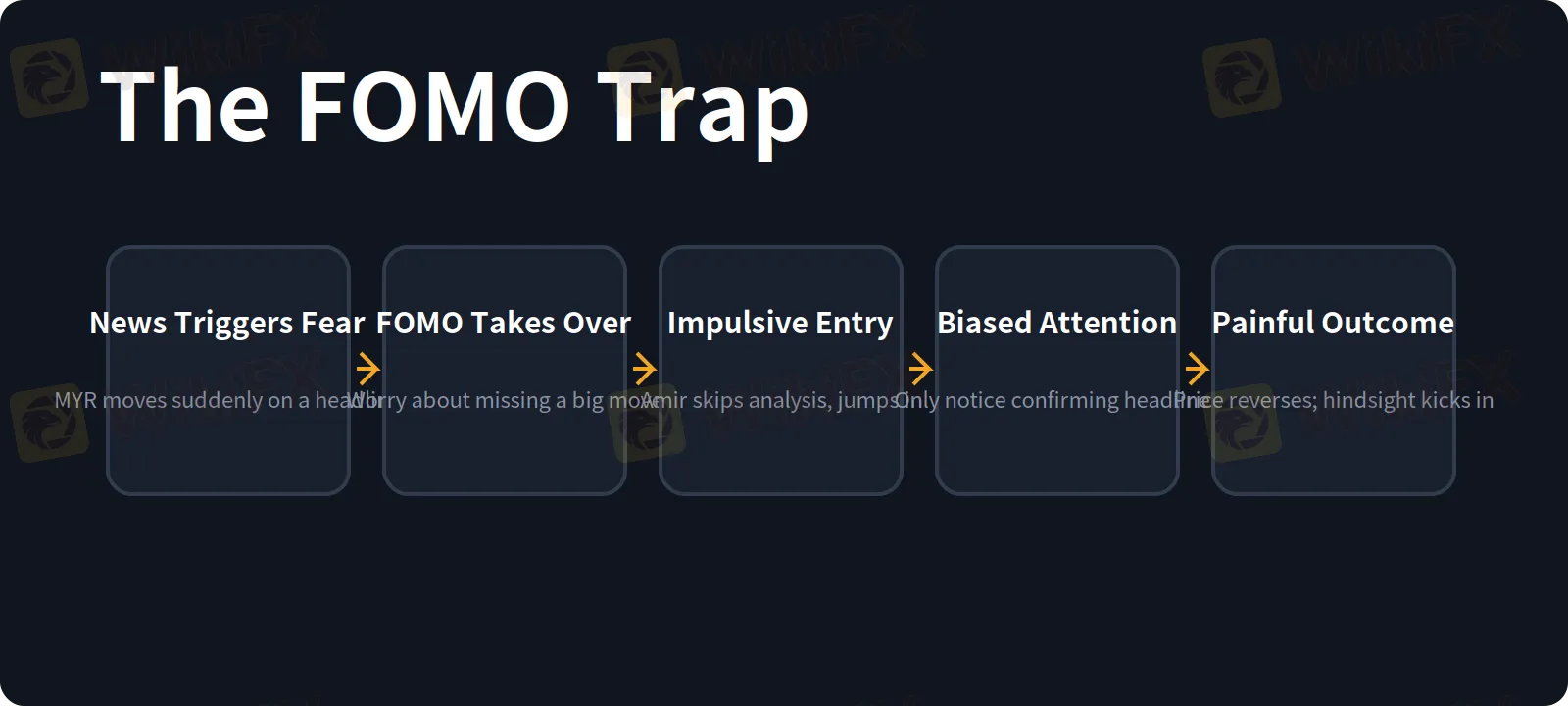
Observe, Dont React: Self-Exercises for FOMO Awareness
The aim here is not to eliminate FOMO – emotions are part of being human. Instead, you can learn to notice the feeling and create a small gap between the impulse and the action. Below are three simple observation-focused exercises you can try in a notebook or a trading journal.
- The six-minute rule. When you feel the urge to jump in immediately after reading a news piece, set a timer for six minutes. During that time, write down the exact headline, the emotion you feel (excitement, anxiety, envy), and what you would normally do. Often, six minutes is enough for the emotional storm to weaken, allowing you to think a bit clearer.
- Evidence audit. Before any news-triggered trade idea, force yourself to list three reasons why the price might move in the opposite direction. This counters confirmation bias and restores some balance. If you cannot think of three credible counterpoints, that is itself a red flag.
- Replay the tape. Once a week, pick one instance where you traded on the back of news and track what happened to the price 30 minutes, one hour, and one day later – even if you did not take the trade. Write down what you would have gained or lost. Doing this repeatedly can deflate the illusion that news equals instant profit.
These are not trading rules; they are awareness tools. The goal is to become more curious about your own mental patterns.
FOMO thrives on speed and noise. The MYR can move fast on data releases, central bank statements, or global risk shifts, but none of those events demand an instant reaction from you. The next time a headline makes your pulse race, remember that the only thing you are truly missing out on is the chance to think clearly.
Disclaimer:
The views in this article only represent the author's personal views, and do not constitute investment advice on this platform. This platform does not guarantee the accuracy, completeness and timeliness of the information in the article, and will not be liable for any loss caused by the use of or reliance on the information in the article.
WikiFX Broker
Latest News
FxPro Review: Is This 1.80-Rated Broker Safe for Your Funds?
WikiFXRazor Markets Review: What Traders Should Know Before Depositing
WikiFXAGILE GLOBAL LIMITED Review: What Traders Should Know Before Depositing
WikiFXMASTER MIND CAPITALS Review: Withdrawal Complaints Pile Up Against This Unregulated Broker
WikiFXMangaluru Woman, 61, Loses Rs 16.2 Lakh in Facebook Scheme
WikiFXATFX Trading Volumes Drop 29% After Record Q1
WikiFXWhy a 90% Win Rate Can Still Lose You Money
WikiFXAI GOLD Review: Is Your Deposit Safe?
WikiFXFD Review: What Traders Should Know Before Depositing
WikiFXOANDA Broker: Regulated but Is It Really Safe for Traders?
WikiFX