

Global Broker Regulation Inquiry App
About WikiFX
English
简体中文
繁體中文
English
Pусский
日本語
ภาษาไทย
Tiếng Việt
Bahasa Indonesia
Español
हिन्दी
Filippiiniläinen
Français
Deutsch
Português
Türkçe
한국어
العربية
اردو



Why Betting Your Entire Account Triggers Early Margin Calls

WikiFX
|


Abstract:Beginners often blow their trading accounts by using maximum leverage and risking their entire balance on a single trade. A few consecutive losses can quickly trigger a margin call if position sizes are too large. By risking only 1% per trade, traders can survive the inevitable losing streaks and learn without the stress of an empty account.
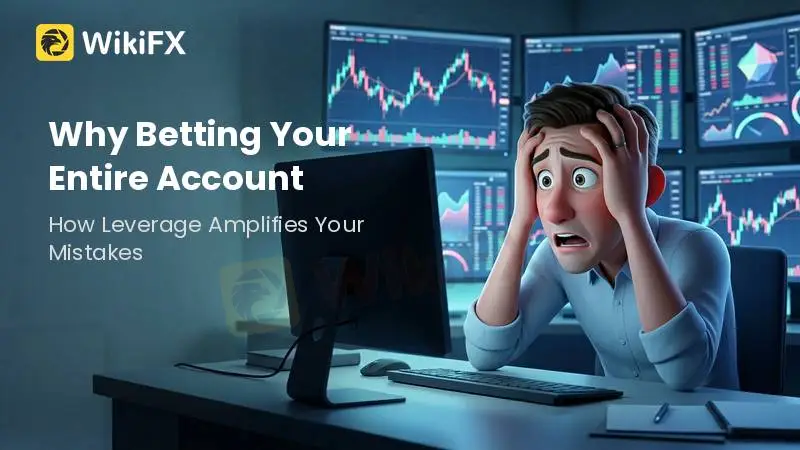
Many beginners enter their first Forex trade confident that the market will move exactly as they predicted. They rely on high leverage, load up an oversized position, and stare at the screen. When the price inevitably dips, panic sets in.
The core problem here is not bad timing or an inaccurate strategy. It is terrible position management.
Trading is a game of probabilities, and it is not a fair 50/50 coin toss. Because of broker spreads and transaction fees, you start slightly disadvantaged the moment you open a trade. If you bet all your capital on a single setup, that small mathematical disadvantage, combined with normal market turbulence, will eventually drain your funds.
 Contents
How Leverage Amplifies Your Mistakes
Many brokers offer high leverage, sometimes 100:1 or more. This means $1,000 of your money can control an actual market position of $100,000. While this sounds like a fast track to large profits, it is a double-edged sword. Leverage magnifies both your wins and your losses.
If you use 100:1 leverage, a mere 1% price movement against your position wipes out 100% of your account capital.
Beginners often forget that the market breathes. Prices swing up and down before picking a clear direction. If your position size is too large, you leave your account with no breathing room. A normal market swing will consume your available margin and trigger a stop-out before the trade ever gets a chance to reverse and become profitable.
The Trap of the Revenge Trade
Every trader experiences losing streaks. Having four or five consecutive losses is completely normal and happens to professionals as well. The difference between a surviving trader and a broke trader is how they handle that streak.
A common beginner trap is the revenge trade. Imagine you open a position and lose $60. Frustrated, you decide to double your lot size on the next trade to quickly win back the lost money. You lose again. This time, you loosen your stop loss, hoping the market will turn, and trade even larger.
Suddenly, a $500 account drops to $150 after just four trades. You did not lose because the market was out to get you; you lost because your position sizing was out of control. By increasing your trade size during a losing streak, you forced an early margin call.
Setting a Hard Limit on Risk
To survive in the Forex market, you must calculate your position size before you press the buy or sell button. Experienced market participants follow a simple, unbreakable rule: never risk more than 1% to 2% of your total account balance on a single trade.
If you trade with a $1,000 account, a 1% risk limit means your maximum acceptable loss is $10 per trade. This rule protects your capital aggressively. Even if you lose ten trades in a row, you still retain 90% of your starting balance, allowing you to stay in the game.
Once your dollar risk is locked at $10, you look at your chart. You decide where your stop loss must go to prove your trade idea wrong—for example, 20 pips away from your entry price. You then adjust your lot size so those 20 pips equal exactly $10. Calculating your position size backwards from your risk limit completely removes the anxiety of trading. If the trade hits the stop loss, it is just a minor business expense, not an account-ending disaster.
Prioritize Survival First
Your primary goal as a new trader is to survive long enough to understand how the market moves. Keep your leverage low, respect your stop loss, and limit your risk to a small fraction of your account. Do not try to get rich on a single setup.
Additionally, make sure your margin calls and stop losses are executed fairly. Some untrustworthy platforms manipulate price feeds or widen spreads artificially to trigger stops prematurely. You can use the WikiFX app to check a brokers regulatory background and read user reviews. Verifying your broker ensures that when you do take a loss, it is a genuine market lesson rather than platform manipulation.

Disclaimer:
The views in this article only represent the author's personal views, and do not constitute investment advice on this platform. This platform does not guarantee the accuracy, completeness and timeliness of the information in the article, and will not be liable for any loss caused by the use of or reliance on the information in the article.
WikiFX Broker
Latest News
57 Booked in Pune Forex Scam Probe: The Fake Trading App Checklist Every Indian Investor Needs
WikiFXOANDA Broker: Regulated but Is It Really Safe for Traders?
WikiFXYen Surges on Joint Intervention
WikiFXVonway Review: Users Report Withdrawal Blocks and Account Freezes , What Traders Should Know
WikiFXMangaluru Woman, 61, Loses Rs 16.2 Lakh in Facebook Scheme
WikiFXATFX Trading Volumes Drop 29% After Record Q1
WikiFXAI GOLD Review: Is Your Deposit Safe?
WikiFXFD Review: What Traders Should Know Before Depositing
WikiFXWhy a 90% Win Rate Can Still Lose You Money
WikiFXRazor Markets Review: What Traders Should Know Before Depositing
WikiFX