Abstract:For FXPN, the regulatory picture is complicated and needs careful examination. While the broker does have an official license in one country, there are several serious warning signs. These include a canceled license from a major European regulator, connections to questionable companies, and concerning reports from people who tried to visit their offices.
This analysis will break down each of these issues to give you a clear, fact-based understanding of the risks. We will look at its active license in Belarus, explain the history of its canceled Cyprus license, and share findings from office visits that raise questions about whether the company actually exists in real locations.
When choosing a forex broker, the most important thing to check is whether it follows the rules set by financial authorities. This determines how safe your capital will be and whether the company is legitimate. For FXPN, the regulatory picture is complicated and needs careful examination. While the broker does have an official license in one country, there are several serious warning signs. These include a canceled license from a major European regulator, connections to questionable companies, and concerning reports from people who tried to visit their offices.
This analysis will break down each of these issues to give you a clear, fact-based understanding of the risks. We will look at its active license in Belarus, explain the history of its canceled Cyprus license, and share findings from office visits that raise questions about whether the company actually exists in real locations. As of 2026, this information is essential for any trader thinking about using this broker. A broker's regulatory standing is the most important factor in determining whether you can trust it. To check the claims and review the evidence in this article, traders should look at the detailed information available on platforms, such as WikiFX, before investing.
Understanding FXPN's Official License
NBRB Regulation Details
The first step in checking any broker is looking at their official license. FXPN is run by a legal company called Leverate Capital Markets Limited Liability Company. This company is officially registered and regulated by the National Bank of the Republic of Belarus (NBRB).
Here are the specific details of this license:
While this license is active, it is important to understand what this means compared to other regulators worldwide. The NBRB is not considered a top-level regulatory body. Countries like the United Kingdom (FCA), Australia (ASIC), and Cyprus (CySEC) have much stricter rules about compliance, how much capital companies must keep in reserve, and how they protect client funds. Regulation in Belarus provides a basic legal framework for forex operations but doesn't offer the same level of investor protection or compensation programs found in more established financial centers. So while the NBRB license confirms that FXPN is legally registered in Belarus, this should be considered alongside the more serious concerns about the broker's overall history and operations.
The Major Warning Signs
A Canceled CySEC License
The most concerning piece of information about FXPN's history is its connection to a company that had its license taken away by a top-level regulator. A key company within the broker's corporate family previously had a Market Making (MM) license from the Cyprus Securities and Exchange Commission (CySEC), which has since been canceled.
A CySEC license is highly respected in the retail forex industry. It means that a broker has met strict operational and financial standards, including keeping client funds separate from company funds and participating in an investor compensation fund. It also gives “passporting” rights, allowing the broker to offer services across the European Union.
Having such a license canceled is not a small matter. Regulators like CySEC don't take this step lightly. A license is typically canceled only in cases of serious and ongoing violations. These can include financial misconduct, misleading marketing practices, failure to maintain required capital levels, or a complete breakdown in compliance and corporate governance. For a trader, a canceled license is a fundamental breach of trust and one of the most serious warnings a broker can receive. It shows that the company failed to protect its clients' interests according to the high standards set by a reputable European regulator.
The Connection to Leverate
The canceled CySEC license is connected to the company LEVERATE FINANCIAL SERVICES LIMITED (Cyprus). According to corporate family tree data, FXPN is closely linked to the “Leverate” brand. This connection is a classic high-risk pattern seen in the industry.
When a company connected to a canceled license continues to operate through other related companies, it raises serious questions about their intentions. This practice can be a strategy to avoid the consequences of regulatory action, allowing the same management or ownership to continue seeking clients under a new or different name in a country with less strict rules. The shared “Leverate” connection between FXPN and a company that lost its CySEC license suggests a continuation of operations, rather than a clean break. This link alone should be a major concern for any potential client, as it shows a history of failing to meet top-level regulatory requirements.
Real-World Investigation Results
A Pattern of Missing Offices
Beyond regulatory databases, on-site verification provides a real measure of a broker's legitimacy. Investigation teams have conducted multiple visits to the addresses registered by FXPN, and the results are deeply concerning. A consistent pattern of missing offices has been documented across several countries.
Here is a summary of the findings from these field investigations:
· Visit to FXPN in Belarus: Investigators visited the registered address at 223050 Minsk region, Kolodischi, Minskaya st. 69a-2, Office 34. The result was clear: No Office Found.
· Visit to FXPN in Cyprus: A similar investigation was conducted in Cyprus to verify a presence there. The result was the same: No Office Found.
· Visit to FXPN in Russia: An attempt to locate a physical office in Russia also failed, yielding the same outcome: No Office Found.
What Missing Offices Mean
What does the absence of a physical office mean for a trader? The implications are serious and directly impact risk.
· Lack of Accountability: Without a physical office, there is no real point of contact. If there's a dispute, withdrawal problem, or a more serious issue, traders have no physical address to turn to, making it nearly impossible to hold the company accountable.
· Questionable Legitimacy: Legitimate financial services companies, especially those handling client funds, maintain a verifiable physical presence. It is a basic requirement of corporate governance and operational transparency. The lack of a real office suggests the company may be a “phantom” operation, existing only online.
· High Counterparty Risk: When a broker's true operational base is unknown, counterparty risk increases dramatically. You are trusting your capital to a company whose management, location, and infrastructure are unverified. This uncertainty is a hallmark of high-risk and potentially fraudulent operations.
These findings raise serious questions about the broker's operational integrity. Traders can view the original survey reports and photographs on the FXPN page on WikiFX, providing visual proof that supports these risks.
The Company Network
The “Leverate” Family Tree
The risk associated with FXPN is not limited to a single company. It is part of a complex and suspicious corporate network. An analysis of the broker's corporate “family tree” reveals direct links to several other low-rated, high-risk companies, all operating under the “Leverate” umbrella.
This network of associated companies shows a pattern of questionable operations:
· FXPN: Carries a “High potential risk” warning.
· Leverate: A related company flagged with a “Suspicious Regulatory License” and “High potential risk.”
· Levelmax: Another related company also marked with a “Suspicious Regulatory License” and “High potential risk.”
· BWM Exchange: A third related company identified with a “Suspicious Regulatory License” and “High potential risk.”
This pattern is a significant red flag. When a broker is connected to a group of other companies that are all flagged for suspicious licenses and high risk, it suggests a widespread issue within the entire corporate structure. It is not an isolated problem with one brand but appears to be a deliberate operational model built on regulatory uncertainty and lack of transparency.
Dangers of Unclear Structures
Such complicated and non-transparent corporate networks are often designed for a specific purpose: to hide true ownership, shift accountability, and confuse traders and regulators alike. By operating through a maze of interconnected companies registered in various countries, the ultimate decision-makers can remain protected from responsibility. For a trader, navigating this network is nearly impossible, and trying to seek help in case of a problem becomes a futile exercise. A clear, simple, and transparent corporate structure is a sign of a trustworthy broker; a complex and unclear one is a warning.
Trader Experiences
Common User Complaints
Regulatory analysis and field surveys paint a concerning picture, and this is further confirmed by real-world trader experiences. A review of user feedback reveals a consistent pattern of complaints centered on fundamental operational failures.
Key themes emerging from user reviews include:
· Withdrawal Issues: This is the most common and critical complaint. Users report “constant issues with withdrawals” and state that processing “takes a long time.” Delays or difficulties in accessing one's own funds are a major red flag and often a warning sign of more serious problems.
· Unresponsive Customer Support: Multiple traders have cited a lack of effective customer service. When problems arise, particularly with funds, unresponsive support can leave traders feeling helpless and without help.
· High Entry Barrier: Several users have noted that the minimum deposit, which ranges from $200 to $500 depending on the source, is too high and unfriendly for beginners or those wishing to test the platform with a small amount.
Considering Other Feedback
To maintain a balanced view, it is worth noting that a few positive or neutral comments exist. Some users have mentioned reasonable transaction costs or found the low leverage options suitable for their risk appetite.
One user described FXPN as a “competent broker” despite some problems.
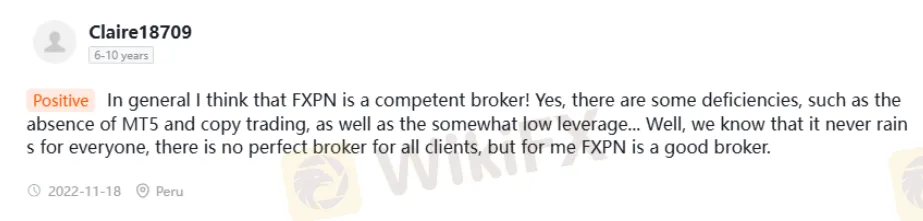
However, these isolated positive remarks are heavily overshadowed by the overwhelming weight of the evidence against the broker. Positive comments about spreads or platforms become irrelevant when a broker is associated with a canceled tier-1 license, has no verifiable physical offices, and faces widespread complaints about its most basic function: returning client funds. The structural and regulatory risks far outweigh any perceived benefits in trading conditions.
Final Assessment and Recommendation
A Summary of Warning Signs
After a thorough examination of FXPN Regulation status, corporate structure, and operational history, the conclusion is clear. The broker shows multiple serious indicators of high risk.
The evidence can be summarized in a simple checklist:
· Canceled Tier-1 License: A clear historical link to a company whose CySEC license was canceled, indicating a past failure to meet high regulatory standards.
· No Verifiable Physical Offices: On-site surveys in three different countries failed to locate any physical presence, suggesting a phantom operation.
· Weak Primary Regulation: The sole active FXPN License is from a non-tier-1 country (Belarus) that does not offer strong investor protection.
· Widespread User Complaints: A consistent pattern of user-reported issues with withdrawals and customer support points to fundamental operational failures.
· Suspicious Corporate Network: Association with a network of other low-rated, high-risk companies.
Putting Capital Safety First
Based on this overwhelming body of evidence, engaging with FXPN presents a high and unacceptable risk to a trader's money. The appeal of any advertised spreads, leverage, or trading platforms is meaningless when a broker fails in the most fundamental tests of legitimacy, transparency, and trustworthiness. In the world of trading, protecting your capital is most important, and choosing a well-regulated, transparent broker is your first and most important line of defense.
We strongly advise all traders to be extremely careful. Before considering any broker, especially one with numerous red flags like FXPN, conduct thorough research. You can access all the detailed reports, license checks, and user reviews for FXPN directly on WikiFX to make a fully informed and safe decision.
Want to be aware of the regulatory status of forex brokers? You cant miss being part of these special chat groups - OIFSYYXKC3, 403M82PDMX or W2LRJZXB7G - where our experts disseminate between regulated and unregulated brokers. Join today to get started.