


India Q1 FY27 GDP Growth Hits 7.8%: 3 Scenarios for INR and Gold
India's Q1 FY27 GDP grew 7.8%, beating a 7.4% poll and RBI's 7.0% projection. See three conditional scenarios for INR, rates and gold.
Original

简体中文
繁體中文
English
Pусский
日本語
ภาษาไทย
Tiếng Việt
Bahasa Indonesia
Español
हिन्दी
Filippiiniläinen
Français
Deutsch
Português
Türkçe
한국어
العربية
اردو




Abstract:The SEC has approved crypto index ETFs by Hashdex and Franklin Templeton, including Bitcoin and Ethereum, marking a milestone in crypto asset investment.
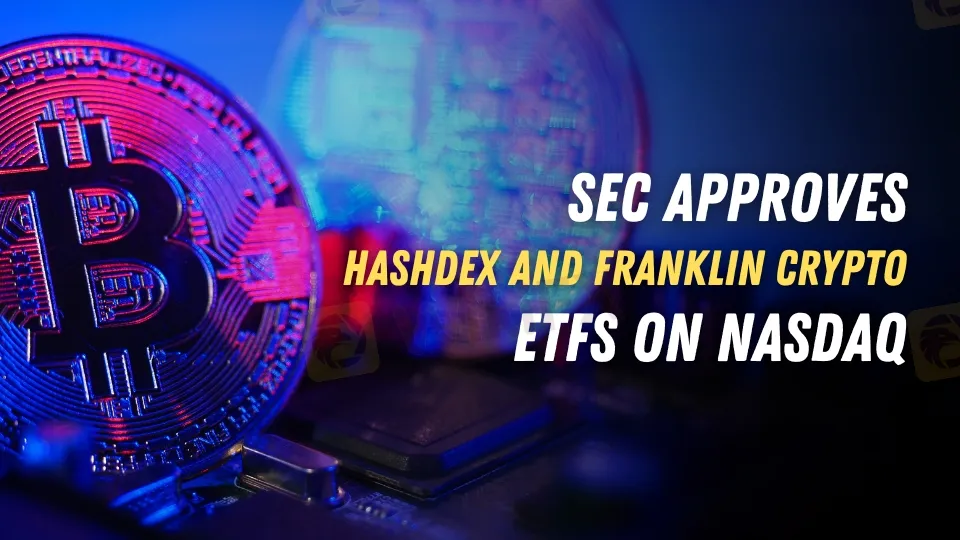
The United States Securities and Exchange Commission (SEC) has approved crypto index ETFs from Hashdex and Franklin Templeton, a significant step forward in the integration of digital assets into regular financial markets. These ETFs, which will be listed on the Nasdaq and Cboe BZX Exchanges, will focus on the two leading cryptocurrencies, Bitcoin and Ethereum.
 Contents
Hashdex and Franklin Templeton's crypto index ETFs will be split 80/20 between Bitcoin and Ethereum based on market size. This structure provides a balanced strategy for investors wanting exposure to the main cryptocurrencies. The Hashdex Nasdaq Crypto Index US ETF will be traded under the ticker “NCIQ,” while Franklin Templeton's ETF will be listed as “EZPZ.” Both funds are scheduled to begin in January 2025.
To boost investor confidence, the ETFs have collaborated with major custodians BitGo and Coinbase to provide secure asset management. Hashdex has also hinted at the idea of expanding its ETF to incorporate other cryptocurrencies, such as AVAX, LINK, and LTC, subject to regulatory permission.
This SEC clearance builds on the success of previous decisions to authorize spot Bitcoin and Ethereum ETFs. Industry analysts predict high demand for these diverse investment alternatives. According to Bloomberg's Eric Balchunas, this milestone highlights Hashdex and Franklin Templeton's expanding importance in the cryptocurrency market.

The overall cryptocurrency ETF market in the United States is quickly expanding. Bitcoin ETFs have received more than $36 billion in inflows, while Ethereum ETFs have received $2.4 billion. Franklin Templeton's Bitcoin and Ethereum spot ETFs alone generated $461.5 million and $41.5 million in net inflows, indicating investor interest in these assets.
While Bitcoin and Ethereum ETFs are growing, Solana ETFs face serious obstacles. Earlier this year, the SEC denied essential 19b-4 filings required for Solana ETF certification, expressing concerns that Solana could be classed as a security. The approval process has stagnated due to a lack of filings, forcing issuers to reconsider their plans.
The SEC's cautious stance is consistent with its prior designation of Solana as a security in court papers. Market observers remain pessimistic that Solana ETFs would be approved by the present administration. According to Nate Geraci, president of The ETF Store, and Bloomberg Intelligence's James Seyffart, Solana ETFs may not be approved until 2025, depending on future changes in U.S. political and regulatory leadership.
The SEC's clearance of Hashdex and Franklin Templeton crypto index ETFs on Nasdaq demonstrates Bitcoin and Ethereum's growing acceptability in traditional financial markets. These ETFs provide investors with a secure and diverse method to interact with top cryptocurrencies. However, the regulatory constraints around Solana ETFs highlight the continued challenges to widespread crypto adoption in financial systems. As the crypto ETF landscape changes, Bitcoin and Ethereum remain at the forefront, laying the groundwork for future innovation in digital asset investment.

Disclaimer:
The views in this article only represent the author's personal views, and do not constitute investment advice on this platform. This platform does not guarantee the accuracy, completeness and timeliness of the information in the article, and will not be liable for any loss caused by the use of or reliance on the information in the article.
India's Q1 FY27 GDP grew 7.8%, beating a 7.4% poll and RBI's 7.0% projection. See three conditional scenarios for INR, rates and gold.
Pakistan remittances reached $3.631 billion in July 2026, up 13% year on year and 4.5% from June, according to the latest State Bank of Pakistan data release. The SBP remittances update is a useful external-sector input, but it is not a currency forecast. This guide explains what the inflow can mean for the Pakistan forex market and USD PKR, and what it cannot prove about the next Pakistan rupee move.
Fed Chair Kevin Warsh is listed to deliver Jackson Hole keynote remarks on 28 August 2026. See the schedule, market scenarios and USD-gold watchlist.

UK retail sales fell 0.5% in July 2026, while the three-month measure rose 1.1%. See the ONS details and what the mixed result may mean for GBP.
WikiFXWikiFXWikiFXWikiFXWikiFXWikiFXWikiFXWikiFXWikiFXWikiFX