Abstract:Between Monday and Friday, at least one of the four major Forex markets is open for business, and two of them overlap three times throughout each 24-hour period. As a result, there is more volatility and liquidity, which leads to tighter spreads and cheaper trading fees and costs. Together, the four sessions account for more than 75% of all Forex trading activity and provide the biggest trading chances.
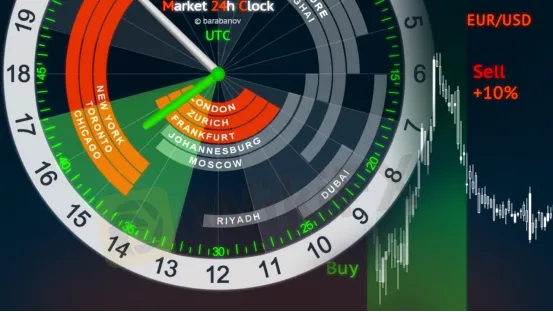
Between Monday and Friday, at least one of the four major Forex markets is open for business, and two of them overlap three times throughout each 24-hour period. As a result, there is more volatility and liquidity, which leads to tighter spreads and cheaper trading fees and costs. Together, the four sessions account for more than 75% of all Forex trading activity and provide the biggest trading chances.
Which are the four major Forex markets, and when do they officially open and close for business?
Sydney opens at 22:00 UCT (17:00 EST) and closes at 07:00 UCT (02:00 EST)
Tokyo opens at 24:00 UCT (19:00 EST) and closes at 09:00 UCT (04:00 EST)
London opens at 08:00 UCT (03:00 EST) and closes at 17:00 UCT (12:00 EST)
New York opens at 13:00 UCT (08:00 EST) and closes at 22:00 UCT (17:00 EST)
Which trading sessions overlap and when?
Sydney and Tokyo between 24:00 UCT (19:00 EST) and 06:00 UCT (01:00 EST)
London and Tokyo between 08:00 UCT (03:00 EST) and 09:00 UCT (04:00 EST)
London and New York between 13:00 UCT (08:00 EST) and 17:00 UCT (12:00 EST)
When Should Traders Trade in Forex to Get the Best Results?
The London-New York overlap accounts for more than half of all worldwide Forex trading activity and is still by far the most important trading time. With around 43% of all trading activity, the UK is the largest single Forex market. With 19 percent, the United States is in second place. Singapore and Hong Kong round out the top five with over 8% apiece, followed by Japan with just under 5%.
The volume of transactions is significant because it has a strong correlation with pip movement: the more money transacted, the more the price moves. The more the price swings, the more money may be made in the market. The London and New York sessions frequently yield the most pip movement in currency pairings and crosses, especially for non-Asian currency pairs.
Forex traders should trade during the following times:
Each of the major Forex market sessions' opening and ending hours. They offer more liquidity, narrower currency spreads, and cheaper trading costs.
Each trading session overlaps, allowing Forex traders to take advantage of the finest trading circumstances possible.
The whole London trading session, which accounts for 43% of total trade volume.
When trading forex, traders should avoid the following situations:
Around noon local time, the four major trading sessions take an unofficial two-hour lunch break. Because of the absence of liquidity, spreads widen, and any established trends are vulnerable to reversals.
It is thirty minutes prior to or following a significant news announcement. These moments are often very unexpected, resulting in false breakouts and breakdowns. News trading is popular, but it's typically too dangerous to be profitable, therefore employing a thorough economic calendar will help you avoid falling into this trap.
What makes the Forex market open 24 hours a day, 7 days a week?
The Forex market is decentralized, with no single exchange or exchanges, and transactions are conducted over the counter (OTC). The electronic communication network (ECN) or other computer networks are used for the majority of transactions. The Forex market infrastructure is built on the lack of centralized exchanges and the use of computers. Every component of Forex trading is automated, which is one of the reasons why algorithmic trading methods are used by so many active market players, both professional and retail.
Market analysts will sometimes refer to a currency closing at a given value. In comparison to the US Dollar, the Euro concluded at $1.1650. This simply refers to the most recent currency rate at the close of business in Europe, which is generally the United Kingdom, Zurich, Frankfurt, or Paris. The EUR/USD will continue to trade 24 hours a day, seven days a week.
The Forex market is open 24 hours a day, 5 days a week, with the exception of weekends and significant public holidays, the market is open 24 hours a day, 7 days a week. This means that retail traders may access the market at any time, not only on weekends, regardless of their geographic location. The Forex market, on the other hand, is most active during the London / New York session overlap, which is widely regarded as the best time to trade Forex, and from the start of the London session to the end of the New York session, which means traders in Europe, Africa, the Americas, and to a lesser extent the Middle East are best placed to trade Forex during the most active sessions. However, because Asian currencies fluctuate a lot during Asian business hours, there are Forex possibilities for traders in Asia even if they don't want to get up in the middle of the night to trade.