

عالمی بروکر ریگولیشن چیک کرنے والا ایپ
WikiFX
اردو
简体中文
繁體中文
English
Pусский
日本語
ภาษาไทย
Tiếng Việt
Bahasa Indonesia
Español
हिन्दी
Filippiiniläinen
Français
Deutsch
Português
Türkçe
한국어
العربية
اردو

TotalFX Dangles 1:1000 Leverage and a $0 Minimum Deposit - But Is Its Regulation Strong?

خلاصہ۔:On the surface, TotalFX reads like a brand-new trader's wish list come to life. No minimum deposit, so you can start with almost nothing. Leverage cranked all the way up to a jaw-dropping 1:1000. Spreads advertised from 0.0 pips. Both MetaTrader 5 and cTrader available. Copy trading baked right in. Tick, tick, tick, tick. If you were building a checklist of "things that make a broker look beginner-friendly," TotalFX would seem to hit nearly every box. But how strong is its regulatory background? Let's find out!
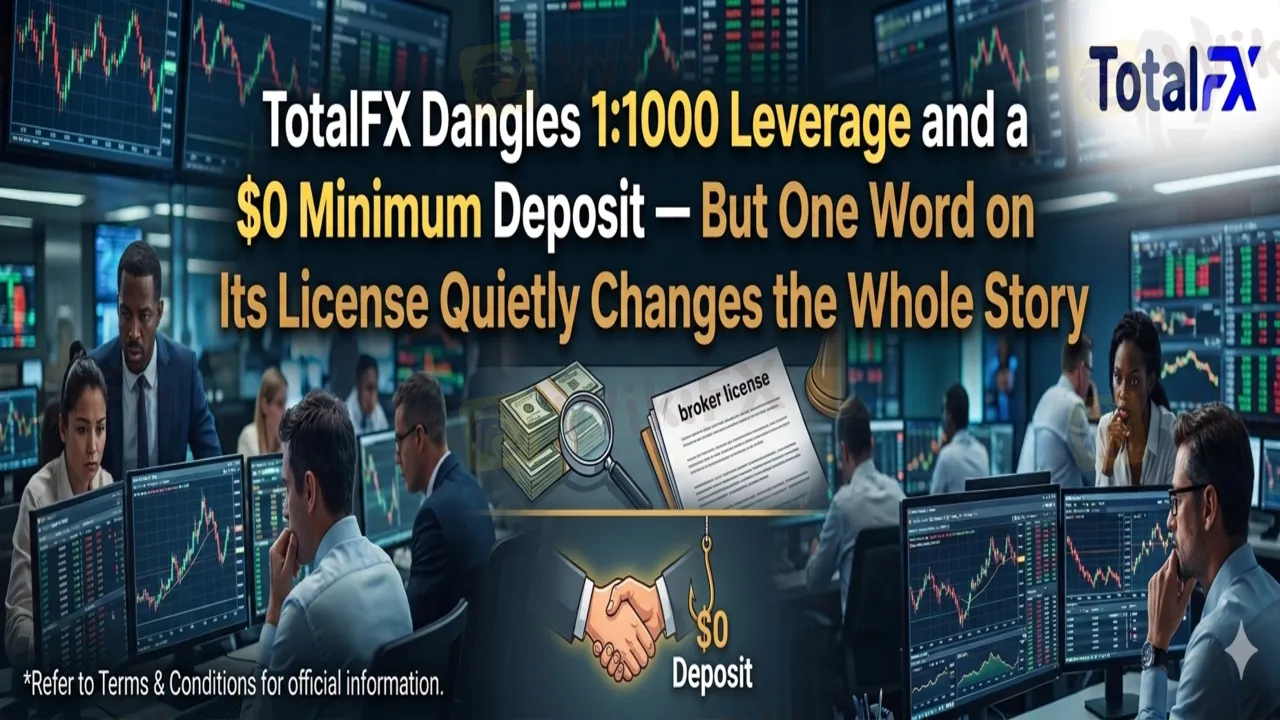
On the surface, TotalFX reads like a brand-new trader's wish list come to life. No minimum deposit, so you can start with almost nothing. Leverage cranked all the way up to a jaw-dropping 1:1000. Spreads advertised from 0.0 pips. Both MetaTrader 5 and cTrader are available. Copy trading baked right in. Tick, tick, tick, tick. If you were building a checklist of “things that make a broker look beginner-friendly,” TotalFX would seem to hit nearly every box. But what about the TotalFX regulation status? Is it regulated? If so, is its regulation robust enough compared to other brokers' regulatory oversight? Have a look!
Who Exactly Is TotalFX?
TotalFX is a CFD and forex broker operating under the legal entity ONAM TRADING (PTY) LTD, headquartered in Cape Town, South Africa, at an address in the Century City business district. According to data on WikiFX, the firm has been operating for roughly two to five years and presents itself as a modern, multi-asset trading destination.
And the asset menu genuinely is broad. TotalFX offers trading across forex, individual company shares, stock indices, cryptocurrencies, metals, energies, ETFs, and soft commodities. For a trader who wants to keep currencies, gold, oil, and a few crypto positions all under one login, that range is appealing.
A quick foundational note for anyone new, because it underpins everything TotalFX sells: a CFD, or Contract for Difference, is a financial product that lets you speculate on whether a price will rise or fall without ever owning the underlying asset. You are not buying actual barrels of oil or actual shares of a company — you are entering a contract with the broker that pays out based on the price movement. CFDs are how the vast majority of retail traders access forex, indices, and commodities, and because they are leveraged products, they carry substantial risk right alongside their flexibility. Most retail CFD traders lose money; that is not pessimism, it is the industry's own published statistic.
The Headline Features, Laid Out
Here is what TotalFX puts on the table, drawn from its WikiFX profile:
| Feature | Detail |
| Account types | “Zero” and “Raw” |
| Minimum deposit | $0 |
| Maximum leverage | 1:1000 |
| Platforms | MetaTrader 5 and cTrader |
| Copy trading | Available |
| Restricted regions | United States, North Korea, Myanmar, Iran |
On the two account types: the Zero account offers spreads from 0.6 pips with no separate commission, while the Raw account offers spreads from 0.0 pips but charges a $2.75 commission per side.
Let's translate that for beginners, because the difference between these two account models trips up almost everyone at first. A spread is the small gap between the price at which you can buy and the price at which you can sell at any given moment — it is the most common way a broker gets paid, baked invisibly into the prices you see. A Raw or ECN-style account gives you the tightest possible “raw” spreads (sometimes essentially zero) but charges a transparent, separate commission instead. “$2.75 per side” means you pay that fee when you open a trade and again when you close it — so roughly $5.50 for a full round-turn standard lot. The Zero account flips the arrangement: no commission, but a slightly wider spread that quietly contains the broker's cut. Here is the key takeaway — neither account is automatically cheaper. Which one wins depends entirely on your trading style, your volume, and the instruments you trade. Do not assume “Raw” means “cheaper” just because the spread number looks smaller.
About That 1:1000 Leverage — Read This Twice
The 1:1000 leverage figure is the feature TotalFX waves most enthusiastically, and it is precisely the feature a beginner should treat with the most suspicion of their own excitement.
Leverage lets you control a large position with a small amount of your own capital. At 1:1000, you could theoretically control a position worth one million dollars while putting up just one thousand. That sounds like a superpower. In reality, it is a magnifier pointed at both your gains and your losses — and losses tend to arrive faster than gains.
Here is the concrete reality. At 1:1000 leverage, a market move of just 0.1% against your position can erase your entire margin. Currency pairs move that much in ordinary minutes. This is exactly why financial regulators in stricter jurisdictions — the European Union, the United Kingdom, Australia — legally cap retail leverage at around 1:30. They did not pick that number arbitrarily; they picked it after watching enormous numbers of retail traders blow up their accounts on high leverage. When a broker offers you 1:1000, it is not doing you a favor. It is offering you a feature that strict regulators consider too dangerous to permit. Treat that as the warning it is.
Understanding the Regulator Itself: The FSCA
To weigh that “exceeded” flag properly, you also need to understand the regulator behind it.
The FSCA is South Africa's financial markets conduct authority — the successor to the old Financial Services Board. It is a real, functioning regulator that licenses financial service providers and is tasked with protecting consumers and policing market conduct. So this is not a fake or imaginary watchdog.
However — and this is critical context that beginners rarely hear — the FSCA is widely regarded by independent reviewers as a lighter-touch, offshore-style regulator when compared to the so-called “tier-one” authorities like the FCA or ASIC. Its investor-protection and compensation mechanisms are considerably more limited. In practical terms, an FSCA license offers meaningfully weaker guarantees around the safety of your funds than a top-tier license would.
There is one more wrinkle that makes verification genuinely difficult here. The FSCA does not publish the websites or brand names tied to its licensees. A search of the FSCA register confirms that an entity named ONAM TRADING (PTY) LTD exists and is licensed. But because the regulator does not list which websites or trading brands belong to that entity, it is genuinely hard to independently confirm that the TotalFX site you are looking at is truly operated by the licensed company. This gap is exactly the kind of opening that clone brokers — fraudulent operations that impersonate a legitimately licensed firm — love to exploit. It does not prove TotalFX is a clone; it simply means you cannot easily rule it out on your own, which is a transparency problem either way.
Platforms, Copy Trading, and Execution
To give credit where it is due, TotalFX's technology offering is solid on paper. It supports MetaTrader 5 (MT5), the powerful and widely used successor to MT4, as well as cTrader, a platform popular with more advanced traders for its clean order execution and depth-of-market tools. Both are reputable, mainstream platforms — a genuine plus, since proprietary in-house platforms are far harder to trust.
The firm also offers copy trading, a feature that lets you automatically mirror the trades of a more experienced trader. For beginners this can be appealing, but a word of caution: copying someone else's trades does not remove risk, it simply transfers the decision-making. A copied trader can blow up just as easily as you can, and you carry the losses.
WikiFX data also lists an MT5 average execution speed of around 154 milliseconds, which is workable but not best-in-class.
Pros and Cons at a Glance
Pros:
- Wide range of tradable instruments across many asset classes
- Both MT5 and cTrader supported — reputable, mainstream platforms
- Copy trading available for hands-off followers
- No minimum deposit barrier to entry
Cons:
- FSCA provides comparatively limited investor protection versus tier-one regulators
- The regulator does not disclose licensee websites, making the site-to-entity link hard to verify
- Payment and withdrawal methods are not clearly disclosed
- Extreme 1:1000 leverage invites outsized, account-destroying risk for inexperienced traders
TotalFX currently sits at a WikiFX score of around 5.34 out of 10 — a middling number that captures this whole mixed reality with precision: real but limited regulation, decent technology, and unresolved transparency gaps that a careful trader cannot ignore.
The Bottom Line on TotalFX
TotalFX is not a clear-cut scam, and it deserves credit for that distinction. Its FSCA license and its use of mainstream platforms genuinely place it a tier above the faceless, fully unregulated offshore brokers that flood this industry. If you were forced to choose between TotalFX and an outright unlicensed operation, TotalFX is the safer of the two.
Layer on a lighter-touch regulator, undisclosed payment methods, and leverage that strict authorities consider too risky to allow, and you have a broker that demands genuine caution rather than the easy trust its slick feature list invites.
Before you deposit a single cent with TotalFX — or with any broker - that waves a license in your face — verify what that license actually covers. The fastest, clearest way to do that is on WikiFX: search the broker by name and you can instantly see its live regulatory status, real user reviews, exposure records, and overall risk score. A licensed badge means nothing until you confirm what is actually behind it — and WikiFX is built to show you exactly that, in the time it takes to finish your coffee.
Verify the license, not just the logo — then trade with your eyes wide open.
Download the WikiFX App for in-depth broker investigation reports.

More Interesting Articles for You

ڈس کلیمر:
یہ مضمون صرف مصنف کی ذاتی رائے پر مبنی ہے، یہ پلیٹ فارم کی سرمایہ کاری کی مشورہ نہیں ہے۔ پلیٹ فارم مضمون کی معلومات کی درستگی، مکملیت اور بروقت ہونے کی کوئی ضمانت نہیں دیتا، اور مضمون کی معلومات پر اعتماد یا استعمال سے ہونے والے کسی بھی نقصان کی ذمہ داری قبول نہیں کرتا۔
WIKIFX بروکر
ایکسچینج ریٹ کا حساب
USD

CNY
موجودہ ایکسچینج ریٹ:0
براہ کرم رقم درج کریں۔
USD
تبادلہ کے قابل رقم
CNY
حساب شروع کریں 